Home / Water & Watersheds / Rainwater Catchment in Central Texas

Rainwater Catchment in Central Texas

Most people in Central Texas think about rainwater catchment for the first time during a restriction. The city drops you to watering one day a week, the garden you spent four years building starts to look tired, and it occurs to you that a great deal of water fell on your roof last spring and went straight into the street.

The water already arrives on its own. The only real question is whether it soaks into your soil or runs off into the street, and that’s a design decision Symbiosis works out before anything gets built.

How much water are we talking about?

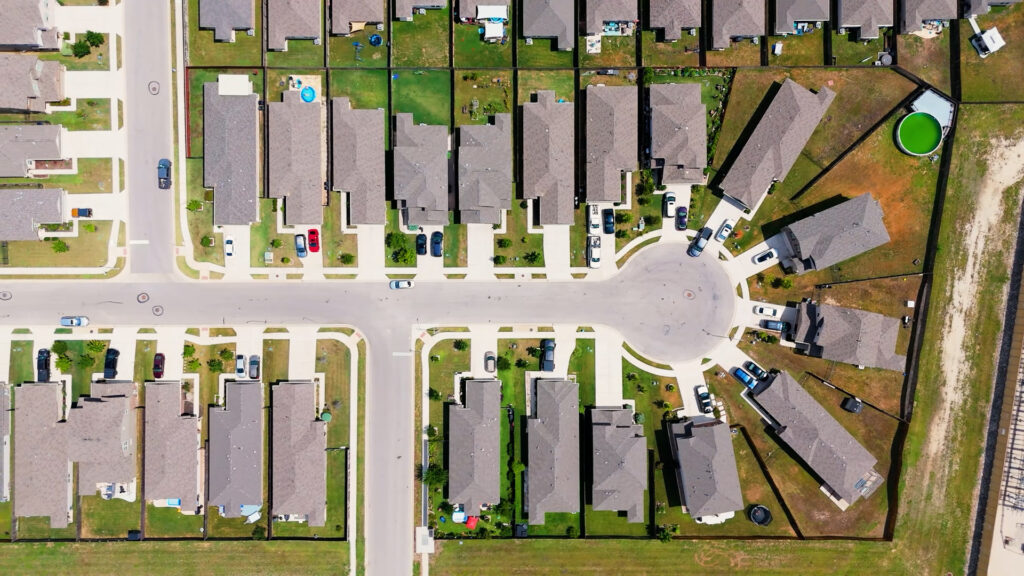
A 1,000 square foot roof sheds about 600 gallons in a single inch of rain. Symbiosis uses that figure, 600 gallons per inch per 1,000 square feet of roof, as the baseline for every tank we size in this region. A typical home with a 2,500 square foot roof loses about 1,500 gallons to the street in that same inch, water that already fell for free and went nowhere useful.

Sizing the tank: the part that's specific to Central Texas

Most sizing guidance assumes rain arrives at a steady rate through the year, but that’s not how it works here. We go months dry, then take ten inches in a handful of storms.

Symbiosis sizes every residential tank for the burst rather than the average. Take your roof’s square footage, divide by 1,000, multiply by 600, then multiply that by 10. A 1,000 square foot roof needs a 6,000 gallon tank. A 3,000 square foot roof needs 18,000 gallons. Skip that final multiplication and the tank overflows in exactly the storm that was supposed to carry you through August.

The goal is a tank that fills in spring, carries you through summer, refills in fall, and carries you through winter, since undersizing just means running out of the water you were counting on. We haven’t had a client yet regret building bigger than the math strictly called for.

A 60,000 gallon tank an HOA approved:

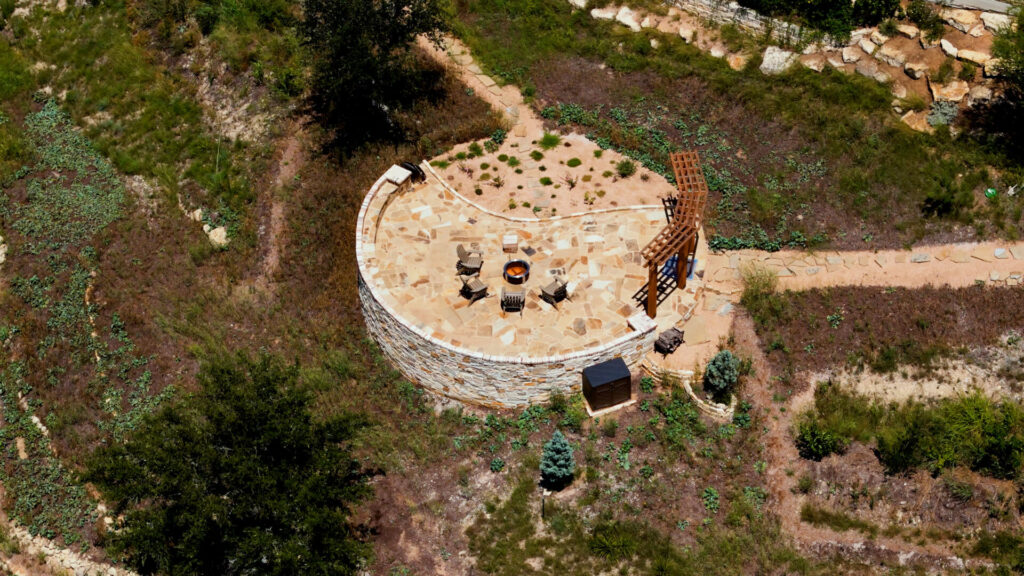
Symbiosis built a system in Spicewood on the steepest hillside we’ve worked, steep enough in places that you had to shimmy along sideways to avoid falling off. The clients were on municipal water, restricted to watering one day a week, and wanted to grow food and medicine rather than watch it die on a schedule.

Their HOA didn’t allow rain tanks of any kind, not above-ground galvanized, not poly, none of it.

So we built a 60,000 gallon concrete tank partially underground, masoned the exterior, and put a patio and a custom pergola on top with swings hanging from it, the whole thing reading as a porch with a view over Lake Travis while quietly serving as the entire irrigation supply for the property underneath.

What that story is really about:

The useful lesson here is less about the engineering and more about how to read an HOA’s actual objection.

An HOA generally isn’t opposed to catching rainwater. It’s opposed to anything it believes will lower property values, and a row of galvanized tanks along a fence line reads that way to a board, whether or not you agree with them. Once appearance is understood as the real objection, the conversation stops being about water and turns into a question of design, and that’s a much easier problem to solve for.

That read holds up in most restricted neighborhoods, since the objection is almost always about how something looks, and that’s something a good design can address directly.

The tank is usually not the whole system

Digging a hole that size produces an enormous amount of material, and on this project, the spoil became the rest of the design. Symbiosis used the excavated rock and soil to build the cliffside into conservation terraces, berms, and swales, then topped them with a mineral blend and planted a food forest into them.

So the property now catches water twice. Roof water goes to the tank. Everything landing on the hillside gets caught by the earthworks and soaks in instead of running off. Two systems, two different scales, solving the same problem, and built together they cost less than either would have cost alone.

Two things happened afterward that weren’t part of the original design. When the clients drained their pool for a leak repair, thousands of gallons went into the new swales instead of down the hill. And the neighbor got in touch to say the storm rubble that used to wash onto their pasture had stopped, replaced by a slow seep coming out of the hillside that now waters their meadow, with frogs and dragonflies showing up on the hilltop as the riparian zone crept upward behind it.

Is a tank right for your property?

A rain tank makes sense if you’re on municipal water with restrictions, on a well you’d rather not lean on, or growing anything you’d be upset to lose in a dry August. It also makes sense if you simply want the water you already receive to be useful instead of wasted.

It’s a poor fit if what you want is the cheapest possible irrigation next month. A tank is infrastructure, and it pays back over years in water you don’t buy and plants that survive summers they otherwise wouldn’t.

If your actual problem is water arriving where you don’t want it, rather than water you wish you’d kept, that’s drainage, and it’s different work entirely.

Where to start

The first step is someone walking the property: roof area, elevations, and where the water needs to go once it’s caught. Tank placement is mostly a gravity problem, and it’s far cheaper to solve on paper than after concrete’s already poured.

If you want a low-commitment way to get that first walk, Symbiosis’s suburban landscape consultation covers exactly this: two hours, one visit, a real read on your property’s water before anything gets designed.

For a fuller design and build process:

Common questions about rainwater catchment:

How big a rain tank do I need?
Take your roof area in square feet, divide by 1,000, multiply by 600, then multiply by 10. That sizes the tank to hold ten inches of rain, which is what Central Texas delivers in a burst. A 1,000 square foot roof works out to about 6,000 gallons.

Is rainwater collection legal in Texas?
Yes. Texas actively encourages it, and there are state-level tax incentives around rainwater harvesting equipment. Local rules and HOA covenants are separate, and that’s where most of the actual friction happens.

My HOA doesn’t allow rain tanks. Is there anything I can do?
Usually. The objection is nearly always about appearance, not water. Symbiosis has built partially buried concrete tanks, tanks integrated into hardscape, and tanks disguised as patios or retaining structures, all approved in neighborhoods that ban conventional tanks outright.

Can I drink it?
Potable systems are possible and require a different specification, with filtration and treatment. Most residential systems we build are for irrigation, since that’s where the volume actually gets used.

What about mosquitoes?
A properly built system is sealed, with screened inlets and overflow. Standing open water is a design failure, not a feature of catchment.

Will one tank actually get me through a Texas summer?
It depends on roof area, tank size, and what you’re watering. Sized properly, it carries a well designed landscape through most of a normal summer. Paired with planting that needs little water once established, it goes considerably further.

Where to start:

Residential landscape conversions ask several systems to work together at once: removing and suppressing turf for good, choosing plants matched to your specific site, sizing irrigation to what the planting actually needs, and building hardscape that holds up as the space matures. Getting those decisions right at the design stage is what determines how much work the garden asks of you in the years after.

If you want a low-commitment way to start, our suburban landscape consultation is a two-hour, in-person visit covering exactly this, water, soil, and native plant potential, on your property specifically.

If you already know you want a full design, our Residential services cover both design-only, for anyone who wants a detailed plan to execute themselves or with another installer, and design-and-installation, for anyone who wants the whole process managed start to finish.

Related Educational Context

For foundational context across land regeneration and water health, visit our Central Texas Land Regeneration Education hub.

Rainwater Catchment in Central Texas

How to size a rainwater tank for Central Texas' feast-or-drought rain pattern, and the story…
The NRCS Will Help Pay for Biochar on Texas Land

Last verified August 3, 2026. Payment rates and ranking dates change every year. Confirm current…

Why We Started Building Homes (And How We Do It Differently)

Companion article to our video Why We Started Building Homes (And How We Do It…
Disaster Recovery Grants for Texas Landowners: The 2026 Guide

Last verified August 1, 2026. Program rates and deadlines change. We update this page as…
Root Dysfunction in Central Texas Trees: How to Diagnose, Fix, and Restore Tree Health

Home / Root Dysfunction in Central Texas Trees Girdling roots encircling the trunk can restrict…