Front Yard Lawn Removal: How We Converted a Bermuda Lawn to a Pollinator Garden in Austin, TX
A conventional front yard in Central Texas tends to operate on a self-reinforcing logic. Irrigation keeps the turf alive through summer heat, herbicide removes whatever wasn’t planted, and fertilizer replaces the soil biology that suppression has diminished over time. Each input creates the conditions that require the next one, which means the yard becomes more dependent on intervention as the seasons progress rather than less. When a landscape is managed primarily through suppression, it remains in a state of continuous resistance against the ecological processes that would otherwise shape it. Understanding how land and water systems interact at the scale of a residential lot helps explain why small-scale decisions — including what covers the ground — have cumulative effects on the broader watershed.
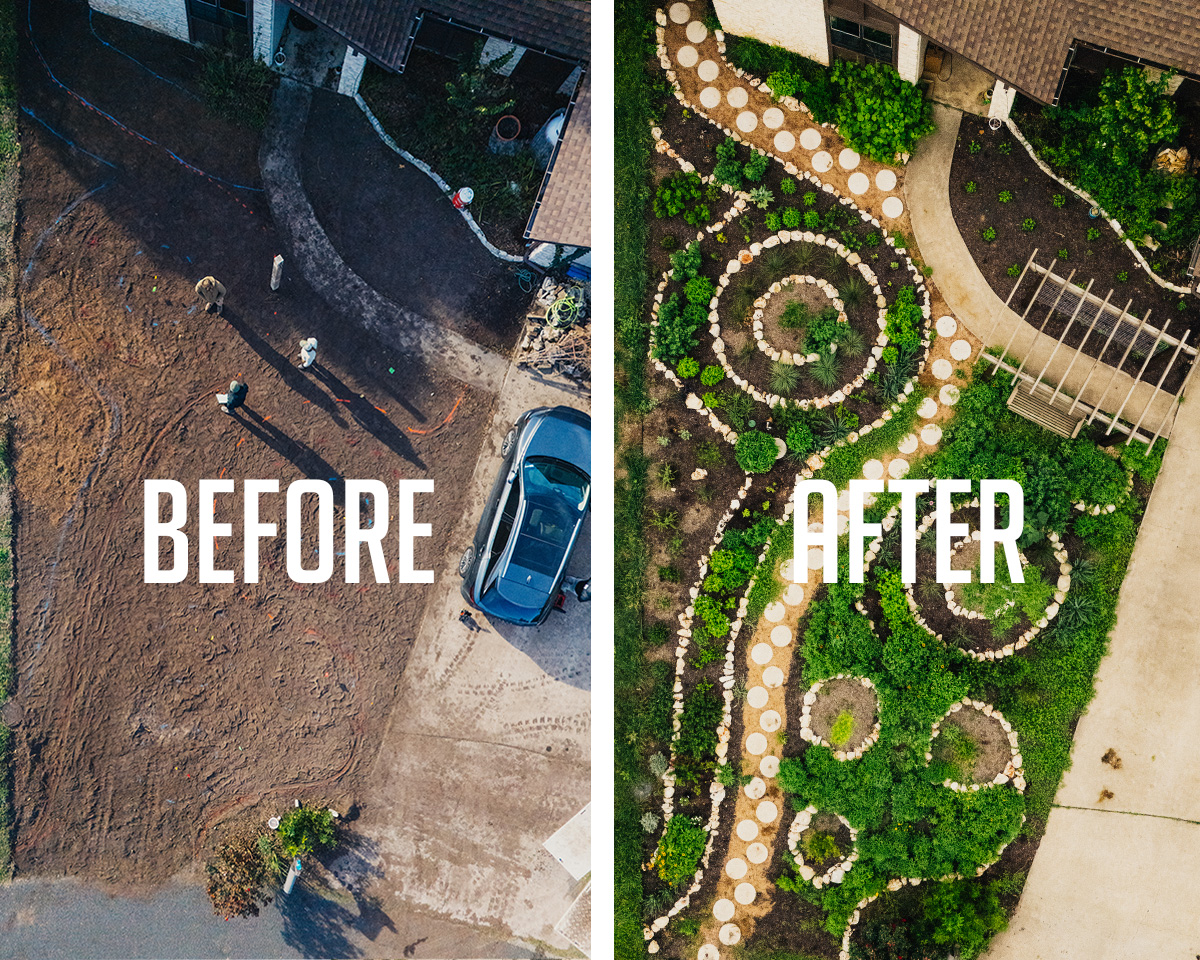
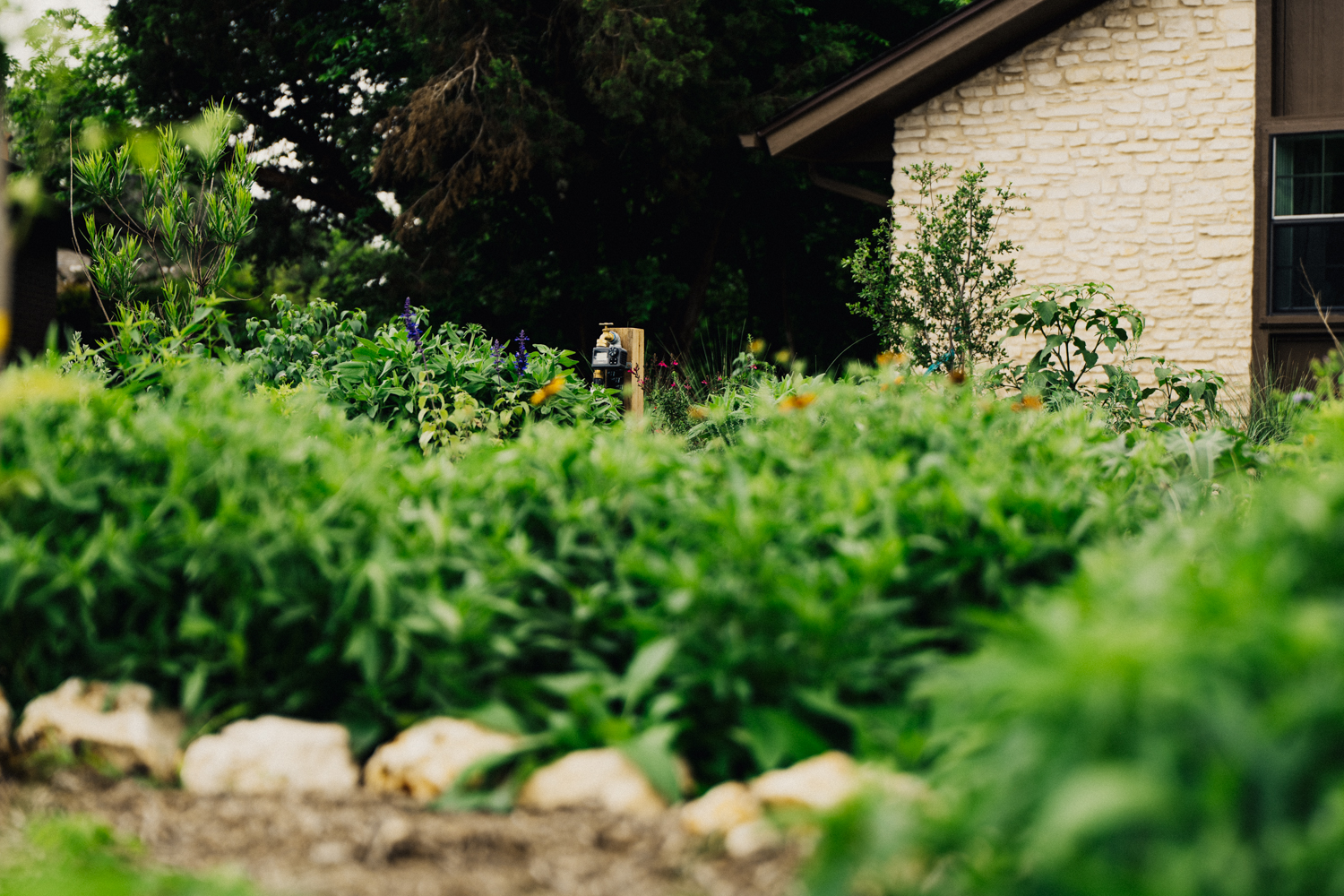
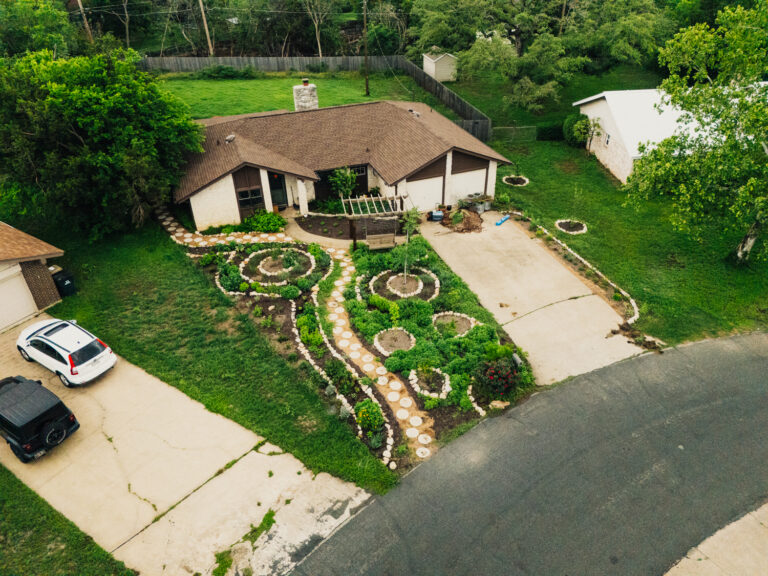
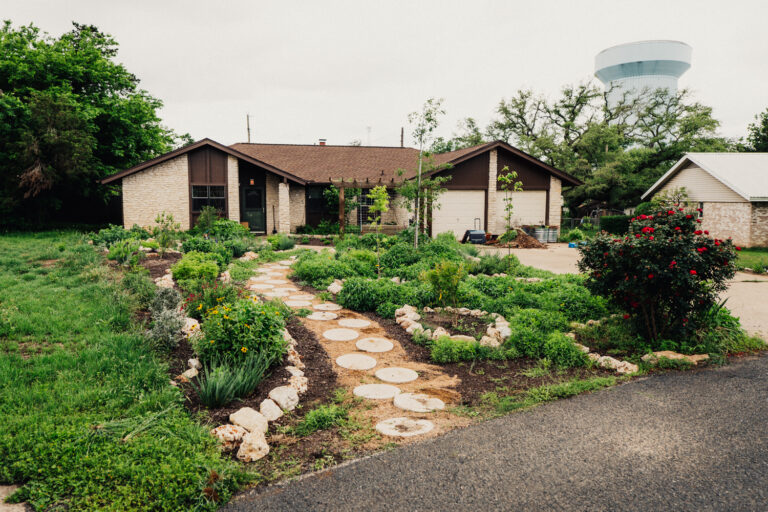
This project began from a different starting point. Rather than asking how to maintain control over the space, the design process asked what the land could reasonably support and what a functioning front yard landscape might look like if it were organized around ecological relationships instead of against them. The roughly 1,900 square foot Austin front yard would become a layered pollinator garden integrated with fruit trees, herbs, medicinals, native grasses, and flowering perennials — a system designed to support wildlife, reduce inputs, and become more self-sustaining over time as the plants mature and the soil develops beneath them. For more on the role of native medicinal and culinary herbs in a Central Texas planting system, see Ancient Healing Secrets of Native Medicinal & Culinary Herbs.
Understanding the Problem: Why Bermuda Grass Is So Difficult to Remove
Key fact: Bermuda grass reproduces through both above-ground stolons and below-ground rhizomes, meaning mechanical removal alone rarely resolves an infestation. Effective suppression requires multiple layered strategies applied over time.
The starting condition was a Bermuda grass lawn, and understanding why Bermuda is so persistent is essential to understanding why front yard lawn conversion requires more than a single removal event.
Bermuda grass (Cynodon dactylon) spreads through two distinct vegetative structures: stolons, which are horizontal stems that creep along the soil surface and root at each node as they extend outward, and rhizomes, which are underground stems that travel through the soil and send up new shoots from below. Both systems can regenerate from small fragments — a piece of stolon or rhizome left in the soil after mechanical removal is capable of producing an entirely new plant, and the rhizome system can extend as deep as several feet in undisturbed soil. The seed bank adds another layer of persistence: Bermuda seeds dispersed across the soil surface can remain viable and germinate independently of the vegetative root system below.
This biology is why a single scalping pass does not resolve a Bermuda infestation. The above-ground plant can be removed entirely while the underground network and seed bank remain fully functional. As Oregon State University Extension notes, rhizomatous grasses like Bermuda are particularly difficult to control because their subterranean structure is protected from surface disturbance. Effective suppression requires a layered strategy that addresses the seed bank, depletes the root system’s energy reserves over time, and changes the conditions at the soil surface so that germination and reestablishment become increasingly difficult.
The removal process on this project used three sequential steps:
- Mechanical scalping at 2 to 3 inches to clear the bulk of above-ground plant material
- A propane torch pass across the prepared soil surface to address the surface seed bank before planting began
- Native seeding with purple prairie clover, white prairie clover, and a Texas wildflower blend from Native American Seed Company, plus soil topdressing and mulch applied at depth
The longer-term suppression strategy is the planting system itself, which works through several overlapping mechanisms. Dense groundcover planting limits the light and space Bermuda needs at the surface. As the fruit trees mature, the developing shade canopy will progressively reduce the conditions favorable to turf regrowth — research has consistently shown that Bermuda loses vigor in shaded conditions, making canopy development one of the most effective long-term suppression tools available. A metal edge along the property boundary physically prevents runners from crossing into the garden from adjacent turf. Limestone riprap defines the interior bed borders and discourages runner encroachment at the garden edges. Each mechanism addresses a different pathway by which Bermuda could reestablish, which is why the combination of approaches tends to outperform any single method over a multi-year timeline.
Why Pollinator Habitat Has to Be Designed, Not Just Planted
Key fact: Planting flowers alone does not create a functioning pollinator habitat. Effective pollinator gardens require spatial clustering of species, bloom time succession from early spring through late fall, and plant selection matched to the foraging range and life cycle needs of native bee species.
Pollinators are not generalists that visit any available flower indiscriminately. Different species have different foraging ranges, flower shape preferences, and seasonal activity windows. Many native bees are small enough that their effective foraging range extends only a few hundred feet from their nest, which means that the density and clustering of food resources within that radius determines whether they can complete a full reproductive cycle. Research from the Xerces Society suggests that planting groupings of at least three feet in diameter of a single species — rather than scattering individual plants — allows pollinators to locate resources more efficiently and collect a full load of pollen and nectar per foraging trip without expending excess energy.
The temporal dimension of pollinator habitat design is equally important. Pollinators need continuous food resources from early spring through late fall, not just during the peak of summer when most ornamental plantings bloom. Early-emerging bees — including bumble bee queens, mining bees, and mason bees — depend on early spring blooms before the bulk of the garden has opened. Late-season species building energy reserves for overwintering depend on plants that continue flowering into fall. A planting that blooms heavily in June and July but offers nothing in March or October functions as a partial habitat at best, sustaining some species during the peak window while failing others at the edges of the season.
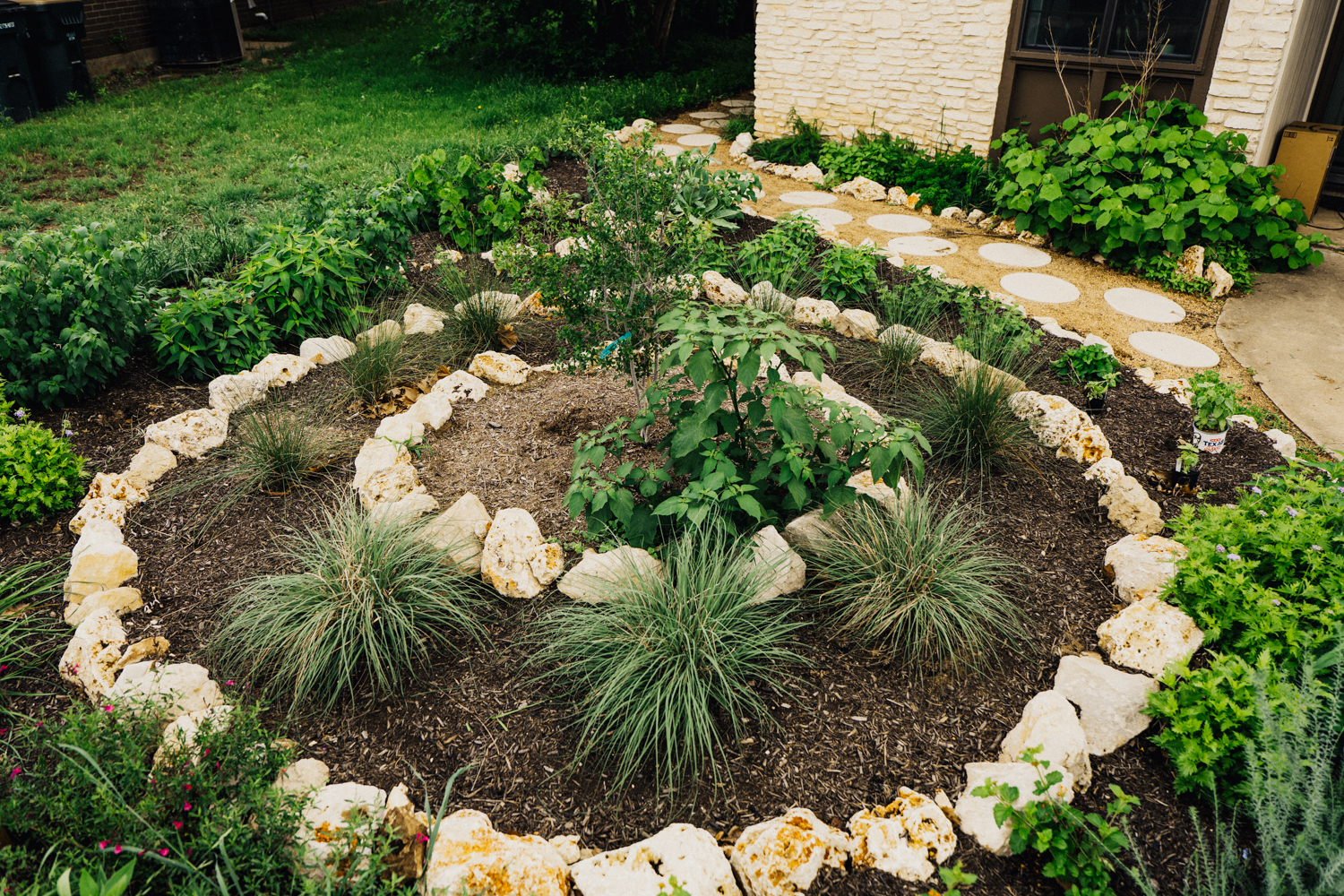
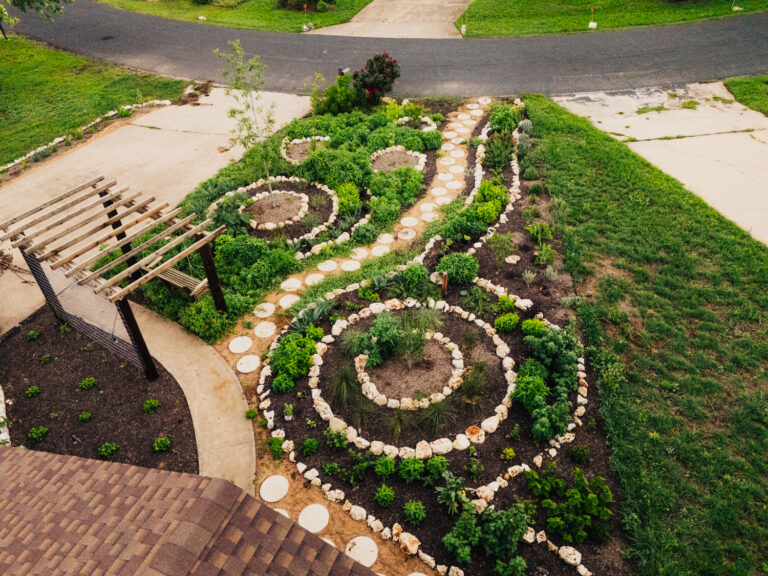
The design on this project addressed both of these dimensions. The selection of species across the planting zones was built around bloom time succession, so that some part of the garden is actively flowering across the full growing season. The concentric ring layout concentrated compatible species in clusters large enough to be visible and useful to foragers. The relationship between the outer flowering rings and the central fruit trees is also functional rather than purely aesthetic: the outer perennials draw pollinators into the system, and the trees — which depend on pollination for fruit production — benefit from that established pollinator traffic once the insects have been attracted into the space.
For Central Texas-specific native plant selection, Texas Master Naturalists maintain regional plant lists tailored to the specific pollinators, soils, and rainfall patterns of the Hill Country and surrounding areas, and are a reliable starting point for anyone building a pollinator garden in this region.
What a Fruit Tree Guild Actually Does
Key fact: A fruit tree guild is a community of companion plants surrounding a fruit tree, each performing a specific ecological function — nitrogen fixation, nutrient accumulation, pest management, or weed suppression — that collectively improves soil health and reduces the need for external inputs over time.
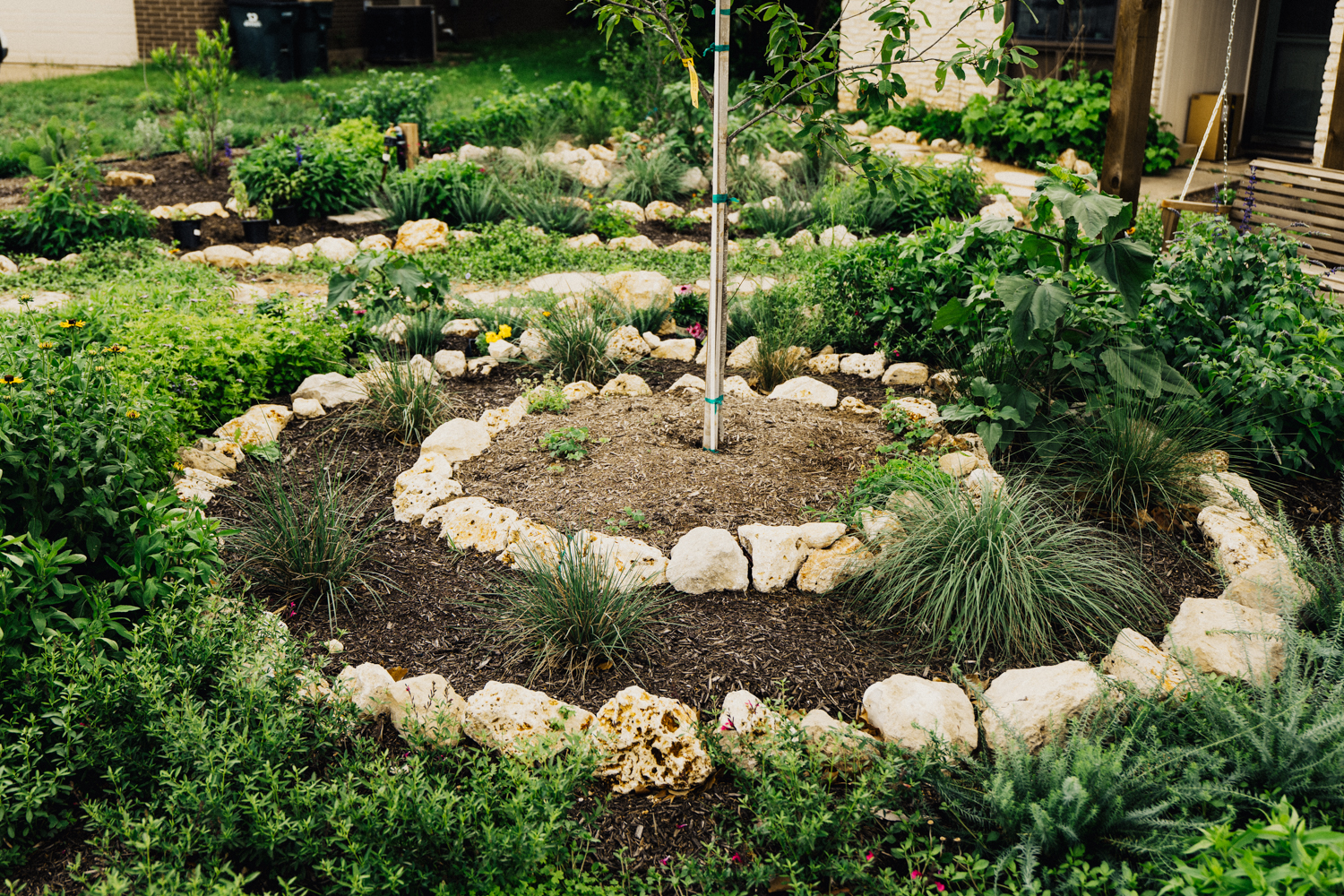
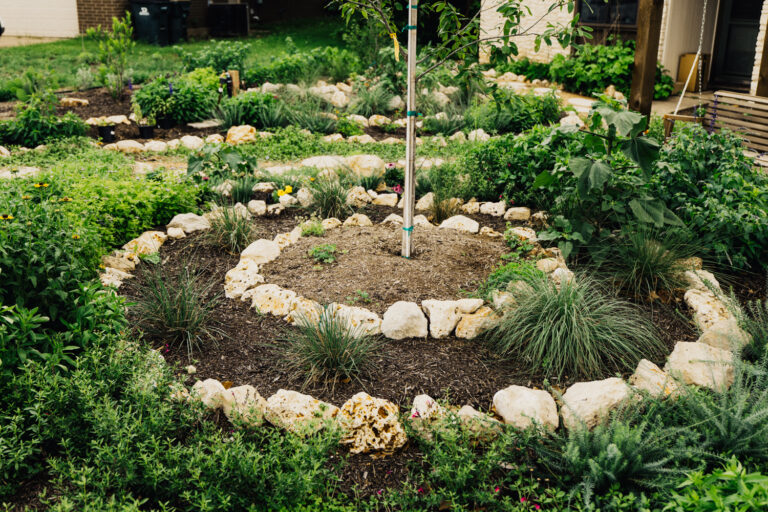
The six fruit trees installed at the center of this garden are not planted in isolation. Each one is surrounded by a companion guild — a community of plants selected to perform specific ecological functions that support the tree’s long-term health and productivity without requiring ongoing external inputs.
The concept of a plant guild is borrowed from natural systems, where trees rarely grow surrounded by bare soil or a monoculture of grass. In functioning ecosystems, the ground plane beneath a tree canopy tends to be occupied by a layered community of species that collectively cycle nutrients, support soil biology, attract beneficial insects, and protect the soil surface.
The four functional categories in a fruit tree guild:
- Nitrogen fixers — typically legumes — host specialized bacteria in root nodules that convert atmospheric nitrogen into plant-available forms, reducing or eliminating the need for supplemental nitrogen fertilizer around the tree
- Dynamic accumulators — deep-rooted species whose taproots reach mineral layers below the depth most other plants access; as they shed leaves and decompose, those minerals become available at the surface
- Insectary plants — attract beneficial insects, both pollinators and predatory species that control pest populations, reducing the tree’s vulnerability to insect damage without chemical intervention
- Groundcover suppressors — occupy the soil surface around the tree’s root zone, preventing grass and weed encroachment while protecting soil from direct sun and moisture loss
The practical outcome of a well-functioning guild is that the soil beneath the tree improves in biological activity and fertility over time rather than declining. For a deeper look at how soil biology drives water infiltration and landscape health in this region, Soil Health as the Engine of Water Health covers the mechanisms that make soil structure so central to outcomes above and below ground.
The Design Structure: Tiers, Rings, and Visual Hierarchy
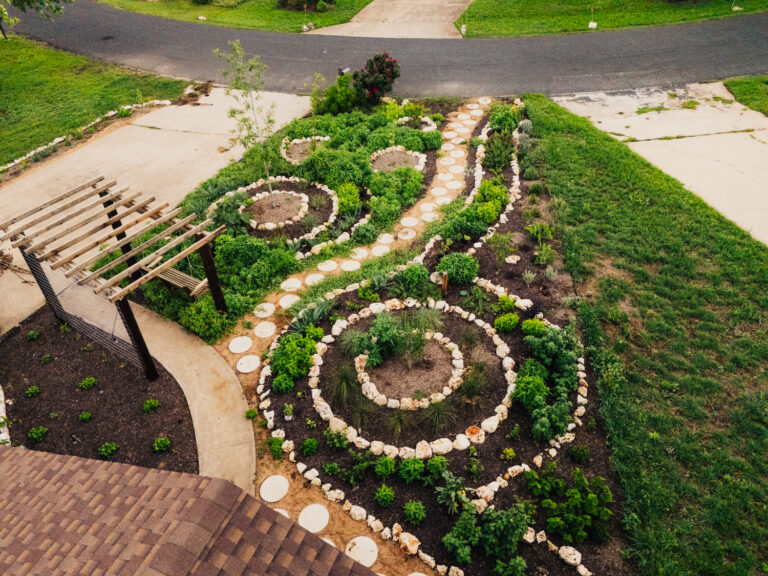
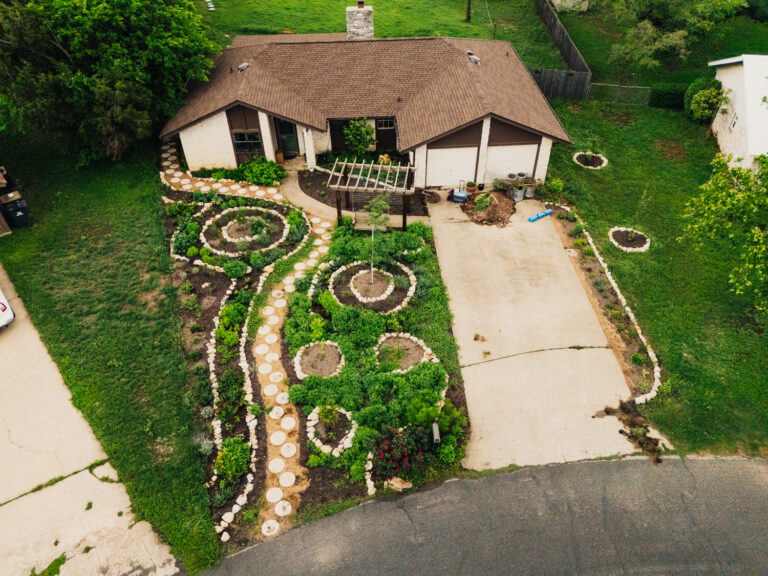
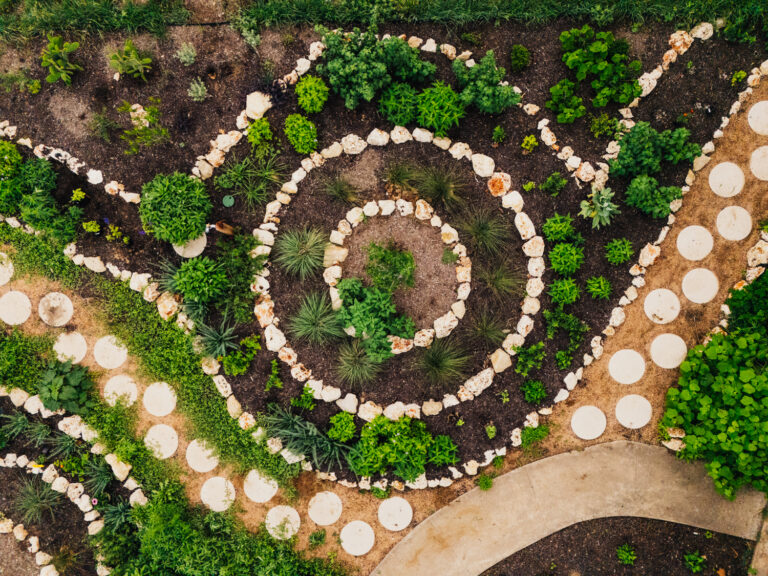
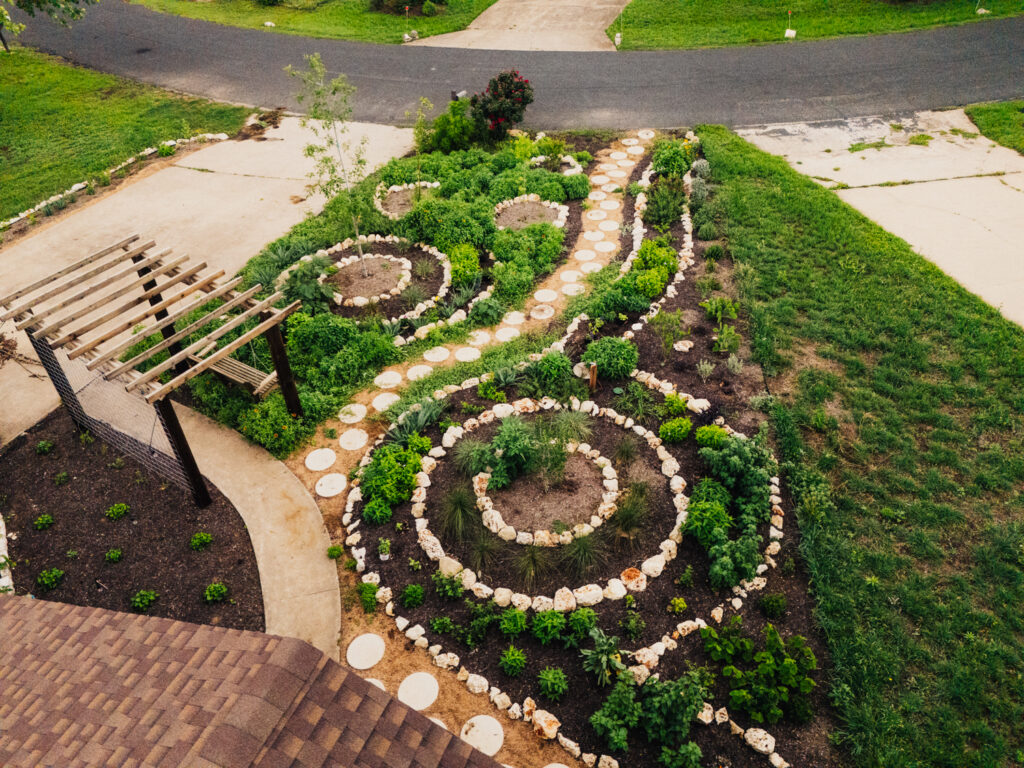
The spatial layout of this garden follows a tiered, concentric structure that serves both ecological and visual purposes simultaneously — a quality that emerges from how plants naturally organize themselves in functioning ecosystems.
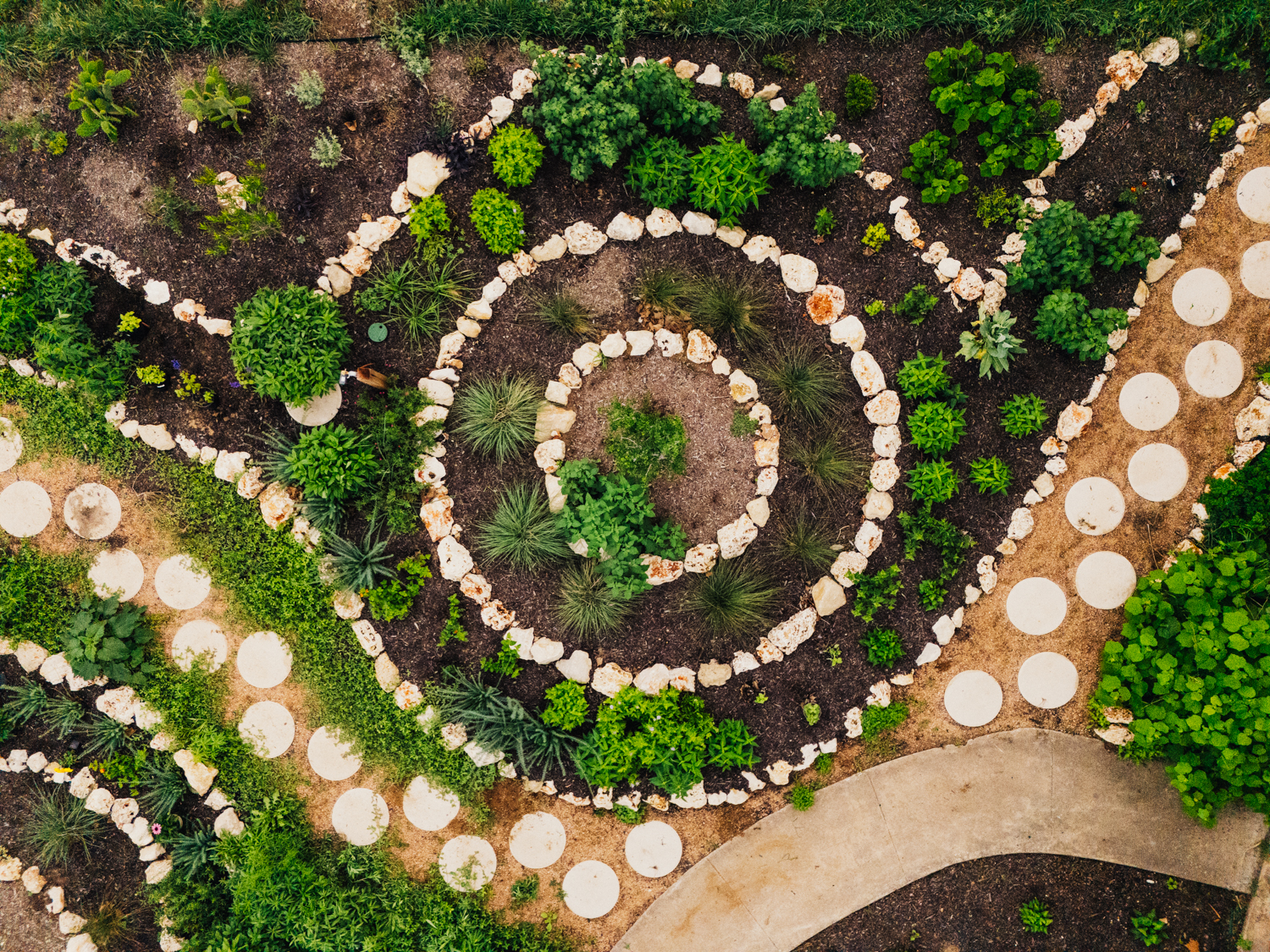
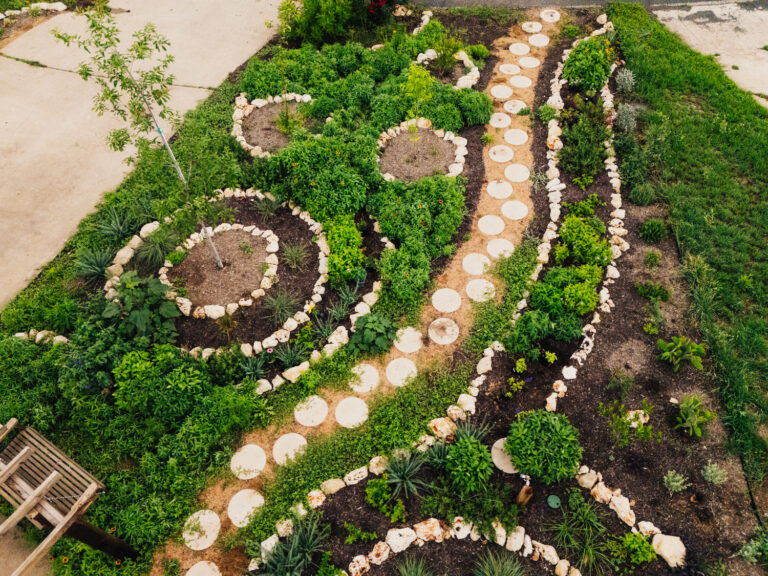
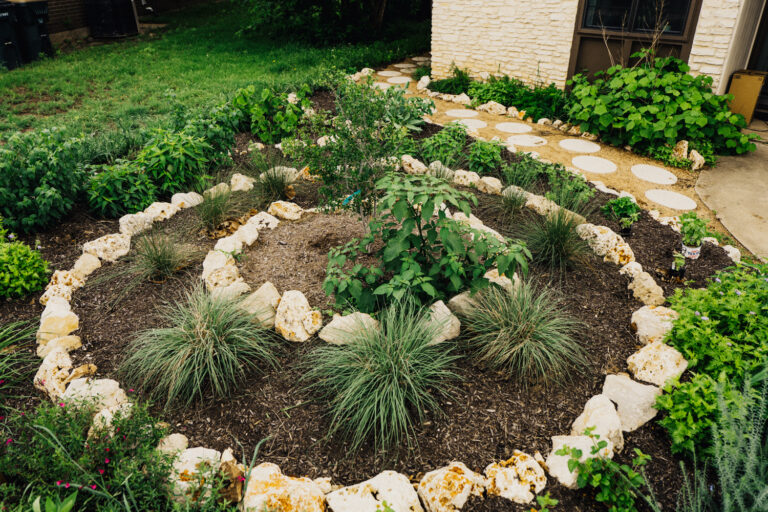
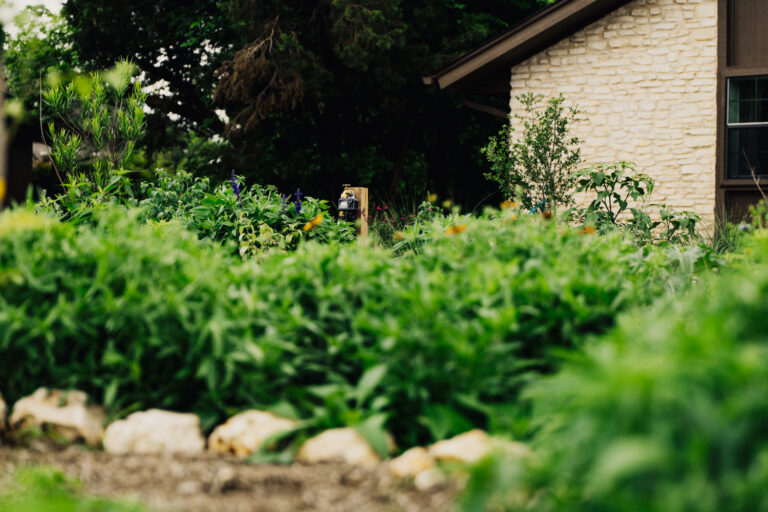
The outermost ring consists of high-contrast flowering perennials selected not only for their bloom time and habitat value but for their visibility from the street and their ability to function as an entry signal for pollinators moving through the neighborhood. Moving inward, a mid-layer of grasses and structural plants provides habitat complexity — overwintering sites for beneficial insects, nesting material, and visual depth. The innermost zone, anchored by the fruit tree guilds, is the productive core of the system, where the most complex ecological relationships are concentrated and where long-term soil development is most intentionally supported.
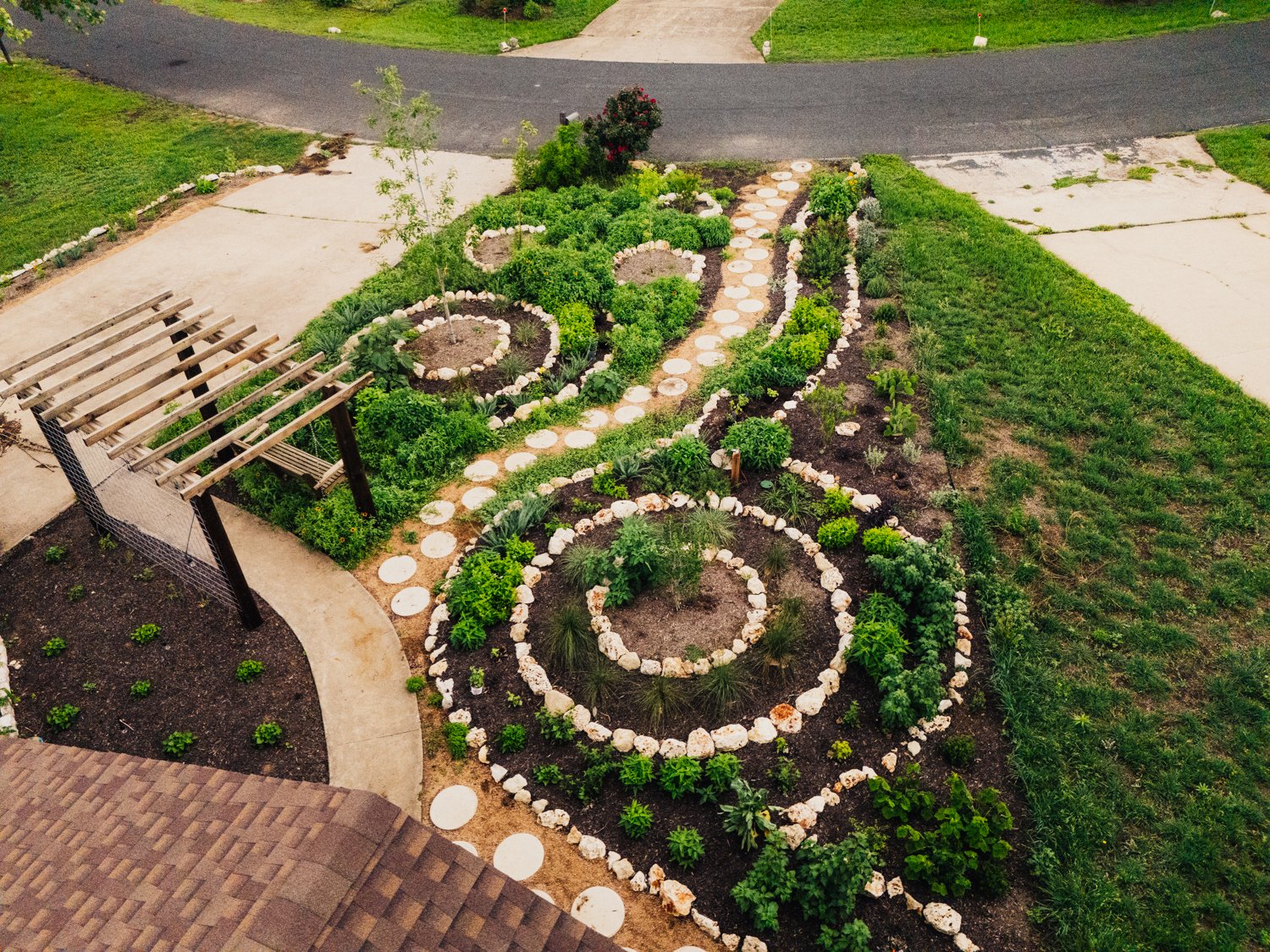
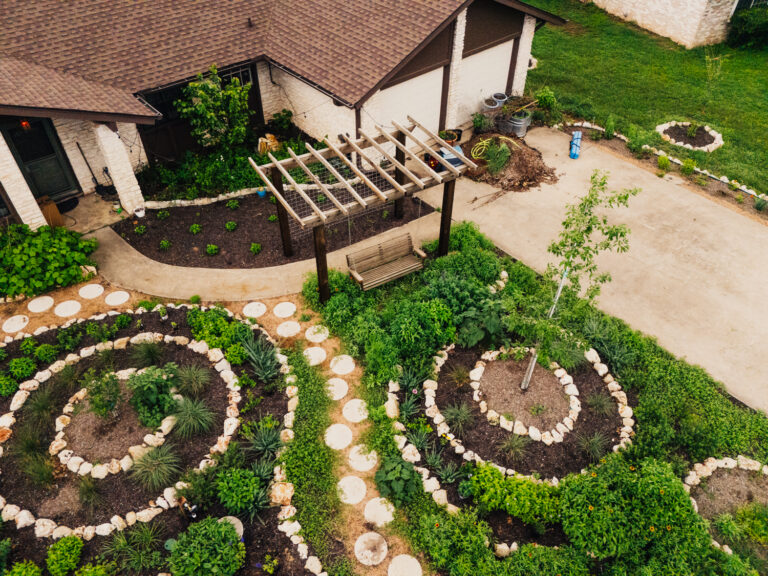
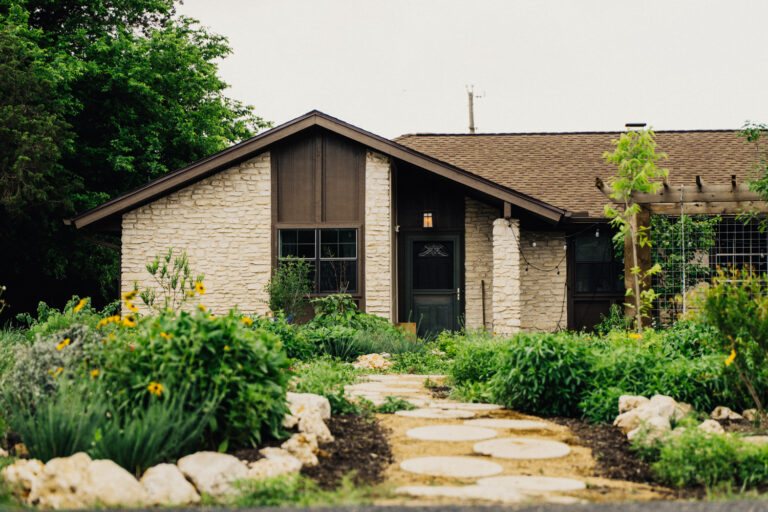
The tiered layout system proved to be one of the more effective organizational frameworks used on this project, giving the installation clear spatial logic, reducing errors during the planting phase, and producing a visual hierarchy that reads well both from the street and from within the garden. The sweeping curves of the bed edges, defined by limestone riprap, create a sense of movement through the space and prevent the static feeling that rectilinear layouts tend to produce in residential yards.
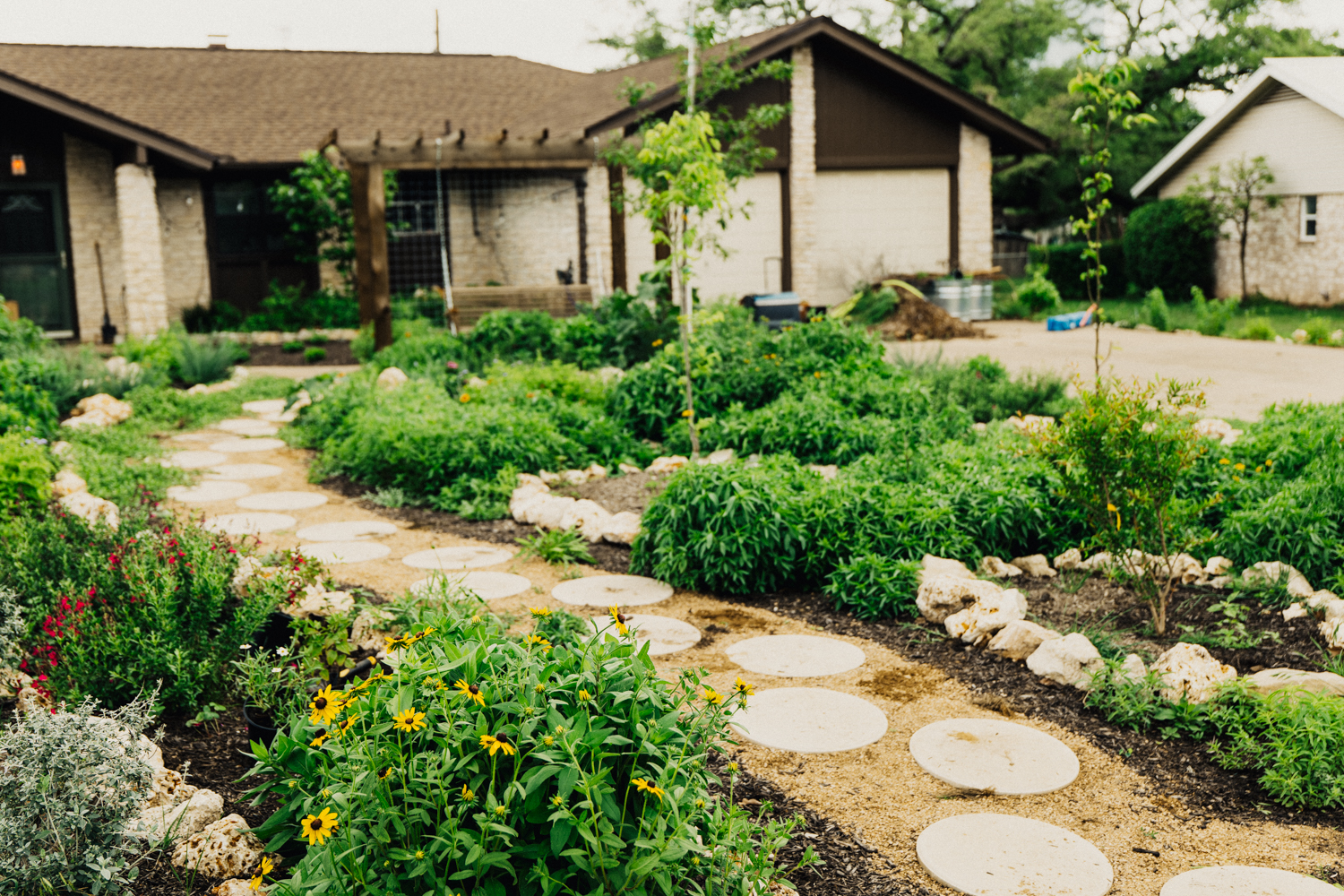
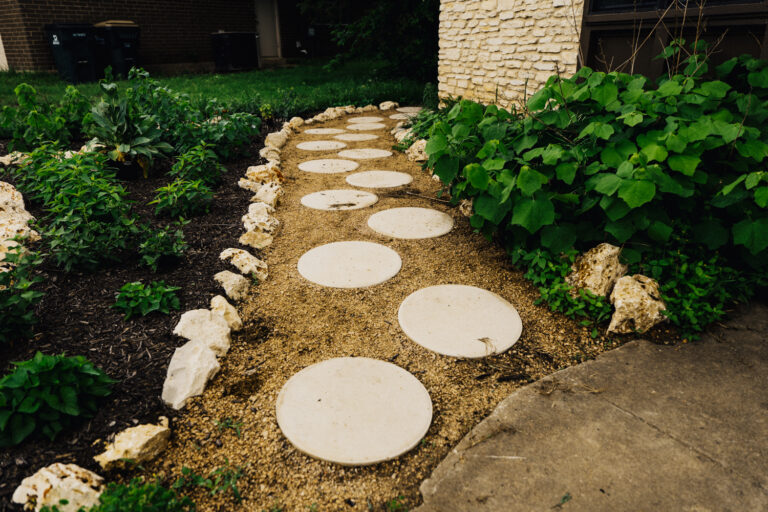
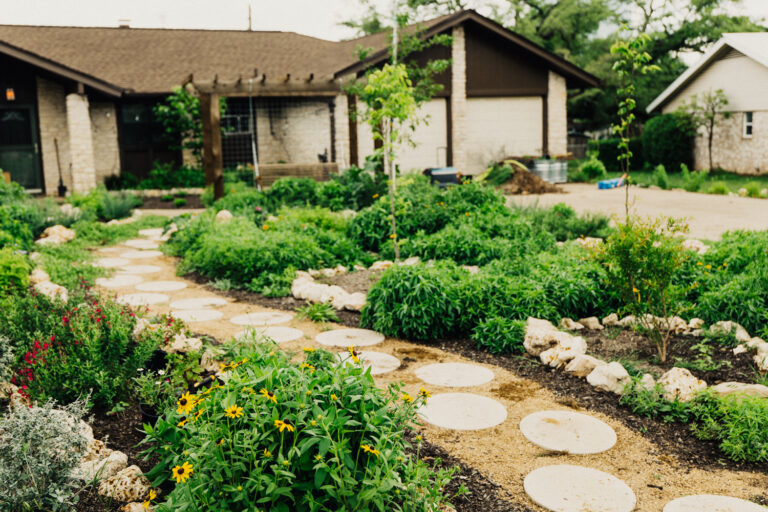
Running through the space is approximately 130 linear feet of circular paver pathway set in decomposed granite. The pathway creates the experience of moving through the garden rather than observing it from outside, which changes how the space is used and how much time the homeowner spends within it.
The Groundcover Mosaic: More Than Mulch
Key fact: A living groundcover mosaic suppresses weeds more effectively than mulch because it occupies the surface layer actively, closing gaps as plants spread and compounding its suppression effect over time. Mulch degrades and requires replenishment; a well-selected groundcover improves with age.
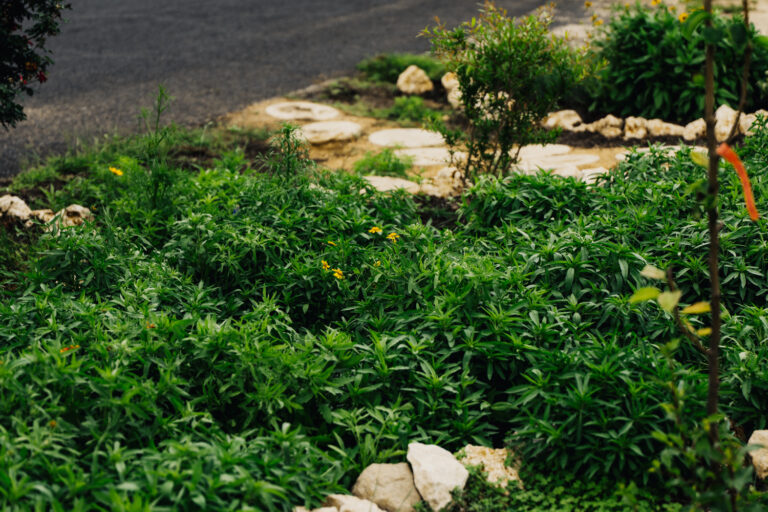
Between the planted beds, a groundcover mosaic of frogfruit, woolly stemodia, and Missouri violet fills the transitions between planting zones. These species were selected not as decorative filler but as functional components of the weed suppression system.
Mulch suppresses weeds by blocking light at the soil surface, but it does so passively and impermanently — it breaks down over time, gaps open as it shifts, and the suppression effect degrades without replenishment. A living groundcover occupies the surface layer actively rather than simply covering it. The plants spread laterally to fill available space, close gaps as they emerge, and compete directly with weed seedlings for light, moisture, and root zone territory. As they mature, the canopy they create at ground level becomes increasingly difficult for new weed growth to penetrate, which means the suppression effect compounds over time rather than requiring renewal.
Three groundcover species used in this project and why:
- Frogfruit (Phyla nodiflora) — establishes quickly, tolerates heat and periodic drought, spreads aggressively to fill available space, and provides continuous bloom through the warm season supporting small native bees
- Woolly stemodia — performs similar suppression functions and adds textural variety to the mosaic
- Missouri violet — selected for shadier pockets where canopy cover reduces available light; proved to be one of the clearest plant selection wins on this project
The mosaic approach contributed to the visual cohesion of the garden significantly earlier than a mulch-only approach would have produced. Within a few months of installation, the groundcover layer had filled in enough to give the garden a finished, intentional character rather than the sparse look that often characterizes new plantings in their first season.
Irrigation: Efficiency as a Design Parameter
Key fact: Drip irrigation delivers approximately 90% of applied water directly to the root zone, compared to 60–75% for conventional sprinkler systems. In Central Texas summer conditions, sprinklers can lose 30–40% of water to evaporation before it reaches the soil — a loss that buried drip lines eliminate almost entirely.
Even drought-adapted native plantings benefit from supplemental irrigation during establishment and through peak heat periods in Central Texas, where summers are long and dry enough to stress young root systems before they have developed the depth to access residual soil moisture. The relevant question is not whether to irrigate but how water is delivered and how efficiently it reaches the root zone.
The irrigation system here uses drip lines buried under the mulch layer throughout the garden, delivering water directly to the soil at root depth rather than broadcasting it overhead. The efficiency difference is measurable: drip irrigation systems deliver approximately 90% of applied water directly to the root zone, compared to 60–75% for conventional sprinkler systems, with the gap widening further in hot, windy conditions where sprinkler evaporation losses increase significantly. Sprinklers can lose 30–40% of water to evaporation during summer afternoons — precisely the conditions that define a Central Texas July — while a buried drip system bypasses that loss pathway entirely. The relationship between surface cover, infiltration, and water movement in the Central Texas landscape is covered more broadly in Urbanization, Permeability, and Water Movement in Central Texas, which provides useful context for understanding why how water is applied at the site scale connects to watershed outcomes.
The mulch layer above the drip lines further reduces moisture loss from the soil surface between irrigation events. The combination means that a given volume of water delivered through a buried drip system does considerably more biological work than the same volume applied overhead, particularly in a climate where evaporation pressure during the growing season is high.
During spring, when rainfall is more consistent, the system may not run at all. Hose-end timers allow seasonal adjustment — scaling up through July and back down as temperatures moderate in the fall — without requiring professional management to operate. Over time, as the planting matures and root systems deepen into the soil profile, the irrigation demand is likely to decrease further, particularly for the perennial species most adapted to the rainfall patterns of the region.
The Riprap Beds: A Lesson in Stone Sizing
Limestone riprap was used throughout the project to define planting bed borders, and the visual result was strong — the stone reads cleanly against the planted beds and integrates well with the overall material palette of the garden. One limitation became apparent during installation that is worth understanding for anyone considering a similar front yard native garden design.
Using a single stone size throughout the riprap border limited how much height separation could be achieved between tiers. The structural logic of riprap stacking works best when larger base stones provide a stable foundation while smaller lock stones fill the gaps between them, increasing holding capacity and allowing for greater elevation change between adjacent planting levels. With only one size available, gaps between stones reduced the stability of taller configurations, which constrained how much vertical separation could be built into the tier transitions.
For tiered riprap bed installations: specifying mixed stone sizing — larger base material with smaller lock stones — increases structural integrity, allows for more pronounced tier height differences, and improves both the visual hierarchy of the beds and their capacity to hold amended soil and moisture at the planting level.
The Pathway and Stabilization
The decomposed granite pathway performs well as a walking surface and integrates naturally with the stone and plant palette of the garden. Psyllium husk stabilization was included in the original project scope as a way to bind the DG surface and reduce displacement under foot traffic, but was not implemented due to timing constraints at the point of pathway construction.
Important note for anyone planning a decomposed granite pathway: psyllium stabilization requires pre-mixing with the decomposed granite before placement — it cannot be applied effectively after the fact. If stabilization is a priority, it must be planned and mixed at the beginning of the process, not added later.
The Arbor
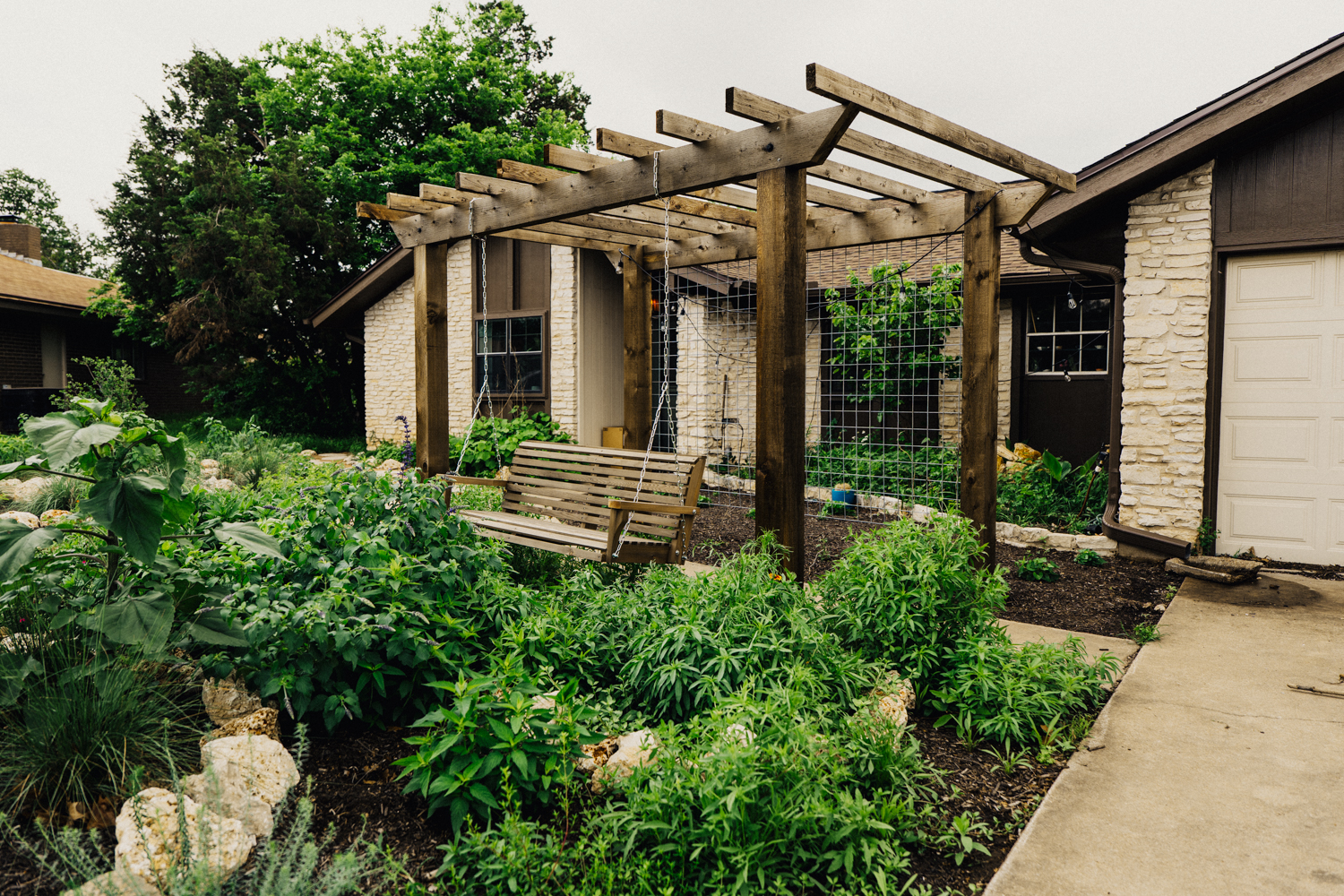
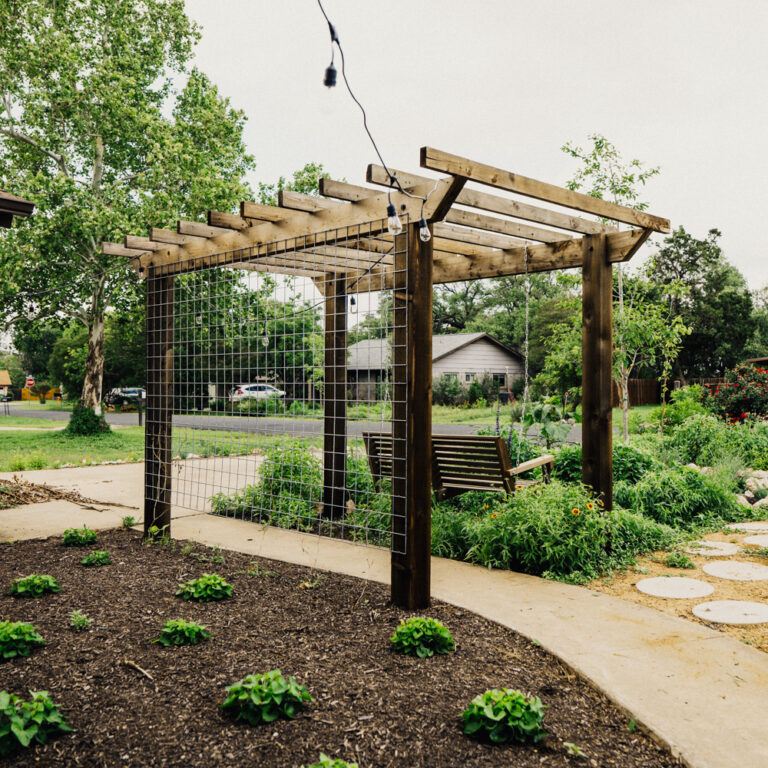
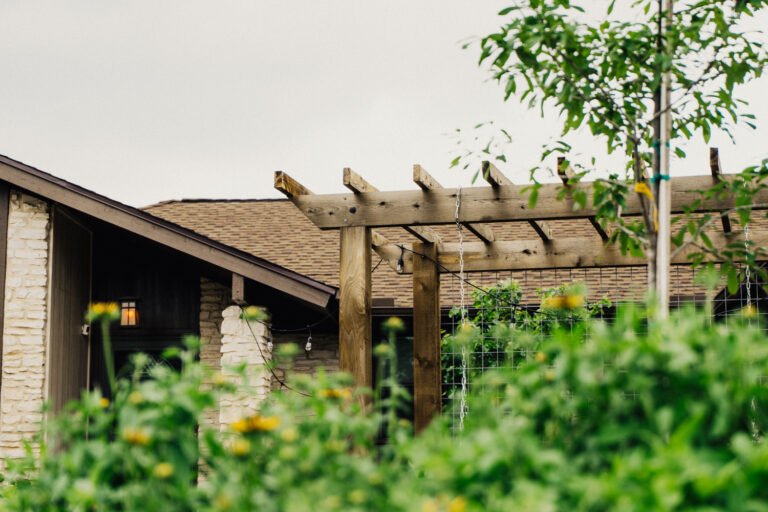
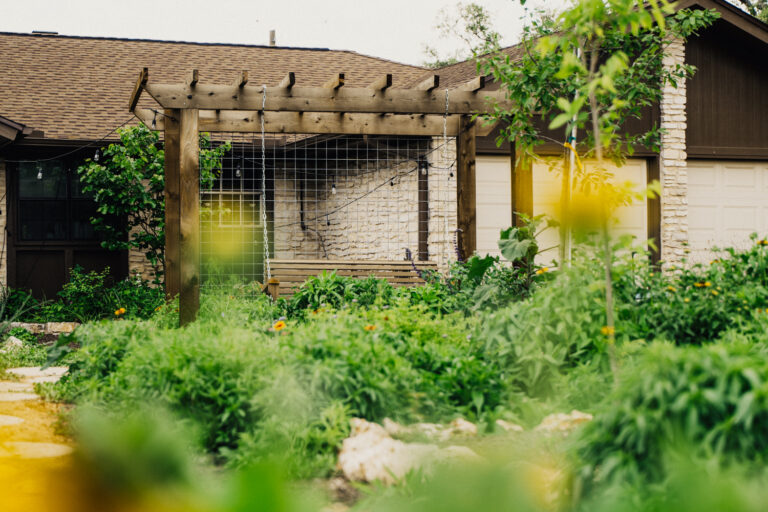
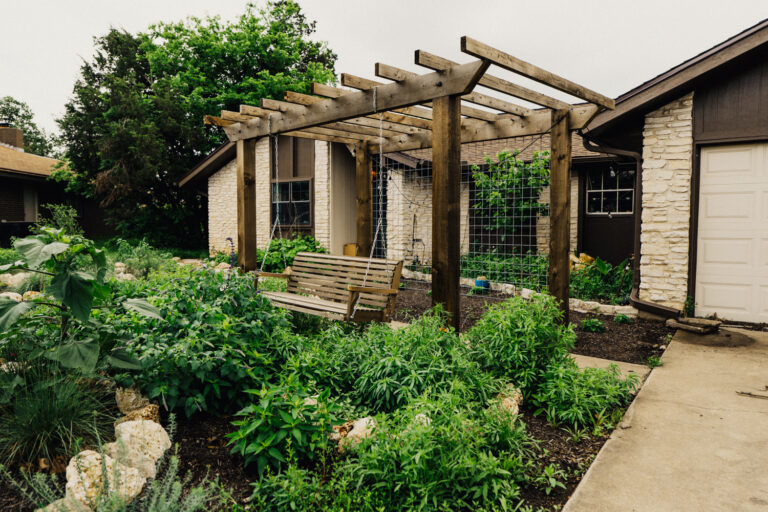
A custom arbor with a swing was constructed along the pathway as a structural focal point and a functional element within the garden. Passion vine is established on the trellis and will extend coverage over the structure over time, providing shade for the seating area and supporting additional pollinator habitat through its bloom period as the plant matures.
The arbor creates a specific destination within the garden — a place to sit and observe the space from inside it rather than from the driveway or the front door. That shift in vantage point tends to change how a yard is experienced over time and how actively it becomes part of daily life on the property. The vertical structure also adds the kind of layered complexity that supports a broader range of species than a flat planting bed alone can offer.
Frequently Asked Questions
How do you remove Bermuda grass without herbicides? The most effective chemical-free approach combines three methods: mechanical scalping to remove above-ground material, flame weeding to address the surface seed bank, and a dense planting strategy that deprives remaining Bermuda of the light it needs to reestablish. Physical edge barriers prevent runner encroachment from adjacent turf. Long-term canopy development from trees contributes additional shade suppression over subsequent seasons. No single method eliminates Bermuda entirely — effective control is cumulative and requires multiple mechanisms working in combination over at least one to three growing seasons.
How much does a front yard pollinator garden cost in Central Texas? Project scope varies significantly based on square footage, hardscape elements, plant density, irrigation complexity, and structural features. This project covered approximately 1,900 square feet and included a full native planting system, buried drip irrigation, limestone riprap bed borders, a 130-linear-foot circular DG pathway, and a custom arbor with swing. Symbiosis offers both design-only and full-service installation paths — reach out at symbiosistx.com to discuss what makes sense for your site.
What native plants work best for a pollinator garden in Austin and Central Texas? Species with strong track records in Central Texas include frogfruit (Phyla nodiflora), woolly stemodia, purple prairie clover, Texas bluebonnets, various salvias, inland sea oats (for shaded areas), and native wildflower mixes tailored to the region. The Texas Master Naturalist Hill Country Chapter and Native American Seed Company are both reliable regional resources for species-specific plant selection guidance.
Is drip irrigation necessary for a native plant garden in Texas? Drip irrigation is not strictly necessary once plantings are fully established, but it significantly improves establishment success and reduces water use during the first one to three years — the period when root systems are still developing their depth and drought tolerance. For a front yard conversion in Central Texas, buried drip lines under mulch represent a significant efficiency advantage over overhead irrigation, particularly during summer months when evaporation losses from sprinkler systems are highest.
What is a fruit tree guild and why does it matter? A fruit tree guild is a community of companion plants installed around a central fruit tree, each performing a specific ecological function: fixing nitrogen, accumulating nutrients from deep soil layers, attracting beneficial insects, or suppressing competing vegetation. The guild reduces or eliminates the need for external fertilizers and pest management while improving soil biology over time. It is a design technique rooted in permaculture practice and adapted from how plant communities naturally organize themselves around trees in functioning ecosystems.

What This Kind of Project Involves
Residential landscape conversions require thinking through several overlapping systems at once: turf removal and long-term suppression, plant selection matched to the specific conditions of the site, irrigation infrastructure scaled to the actual needs of the planting, and hardscape elements that support how the space will be used as it matures. The decisions made at the design stage shape how much intervention the garden requires in subsequent years, which makes the design process itself one of the more important investments in a project like this.
Symbiosis offers residential garden design and installation for properties in Central Texas. Design-only services are available for those who want a detailed plan to execute themselves or with another installer; full-service installation is available for those who want the complete scope managed from removal through planting, irrigation, and structural features. The appropriate level of involvement depends on the project and on what makes sense for each situation.
If you are considering a lawn conversion or front yard redesign in Central Texas, we are glad to talk through what your site might support and what a realistic process looks like. Reach out at symbiosistx.com.
Related Educational Context
For foundational context across land regeneration and water health, visit our Central Texas Land Regeneration Education hub.
Front Yard Lawn Removal: How We Converted a Bermuda Lawn to a Pollinator Garden in Austin, TX
Home / Front Yard Lawn Removal: How We Converted a Bermuda Lawn to a Pollinator…
Root Dysfunction in Central Texas Trees: How to Diagnose, Fix, and Restore Tree Health
Home / Root Dysfunction in Central Texas Trees Girdling roots encircling the trunk can restrict…
What is Biochar and Does It Actually Work?
Home / What Is Biochar? Science, History, Pros and Cons, and Its Role in Texas…
Limestone Terraces in Central Texas for Erosion Control and Soil Building
Home / Limestone Terraces in Central Texas: Erosion Control, Soil Building, and Hill Country Restoration…
Applying Wildfire Science to Land Stewardship in Central Texas
Home / Applying Wildfire Science to Land Stewardship in Central Texas Companion article to Episode…
Overgrazing in the Texas Hill Country
Home / Overgrazing in the Texas Hill Country Why Timing, Movement, and Recovery Matter More…