Home / Soil & Ecology / What is Biochar and Does It Actually Work?

What Is Biochar?

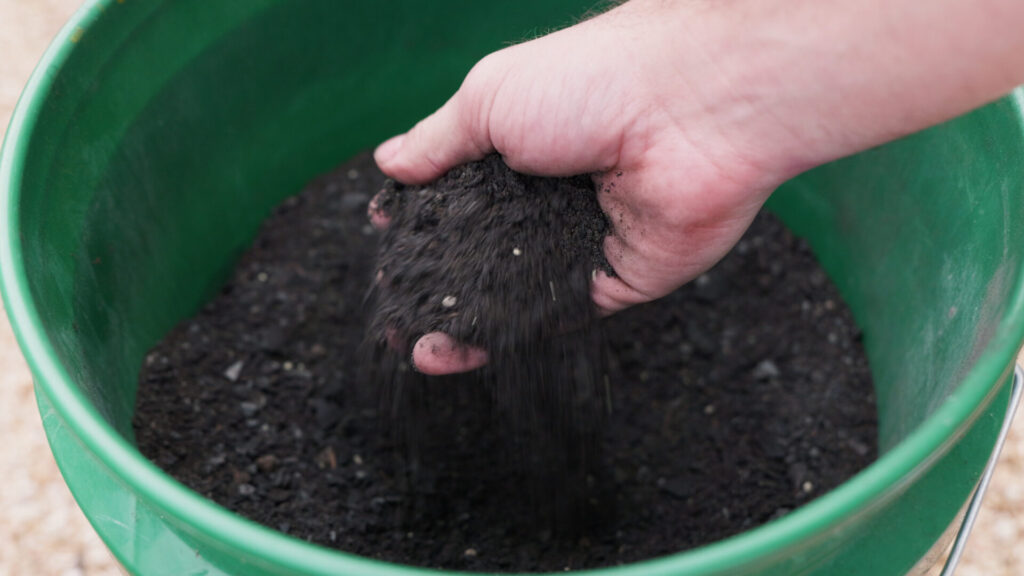
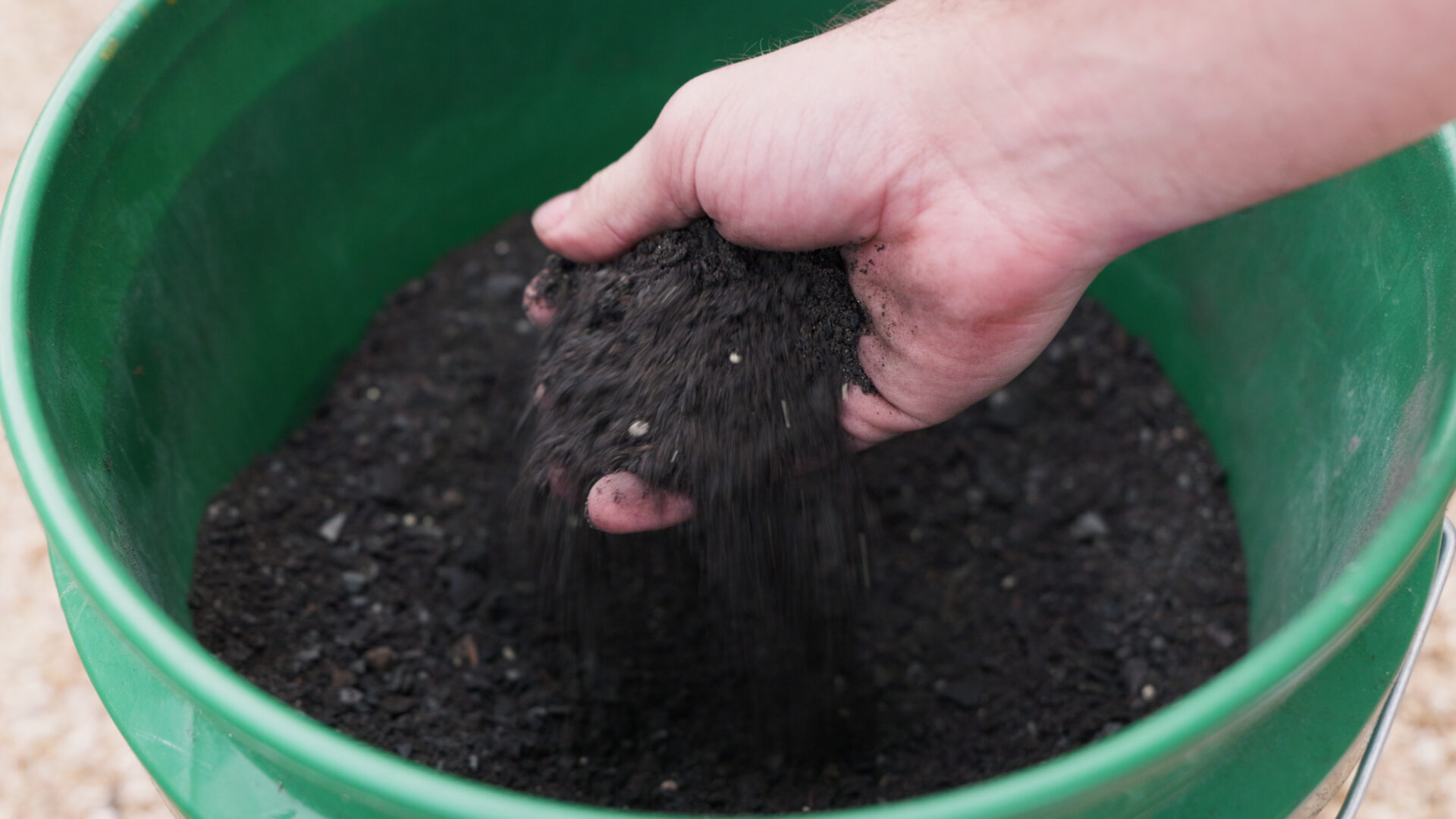
Hand holding biochar soil amendment inside a green bucket in Texas Hill Country

Science, History, Pros and Cons, and Its Role in Texas Hill Country Regeneration

Biochar has rapidly entered modern ecological conversations. It is discussed in regenerative agriculture circles, climate policy forums, university research labs, and backyard gardening communities. Along with that attention has come excitement, strong claims, skepticism, and confusion.

This article is designed to provide clarity.

Below, we break down what biochar is, where it comes from, what academic research says about its benefits and limitations, and how it performs in the Texas Hill Country. If you would rather see the process in action, we also created a companion video that walks through how biochar is produced at scale and how we apply it on active land regeneration projects across Central Texas.

What Is Biochar?

Biochar is charcoal produced from organic material in a low-oxygen environment through a process known as pyrolysis. Instead of fully combusting biomass into ash, pyrolysis transforms plant material into a stable, carbon-rich structure.

Under normal conditions, plant matter decomposes and returns carbon dioxide to the atmosphere within years. Biochar behaves differently. Its carbon structure resists microbial breakdown and can persist in soil for decades or longer.

While the term “biochar” is modern, the practice is not. Indigenous cultures incorporated charcoal into soil systems for thousands of years. The most well-known example is Terra Preta in the Amazon Basin, where carbon-rich soils created centuries ago remain fertile today.

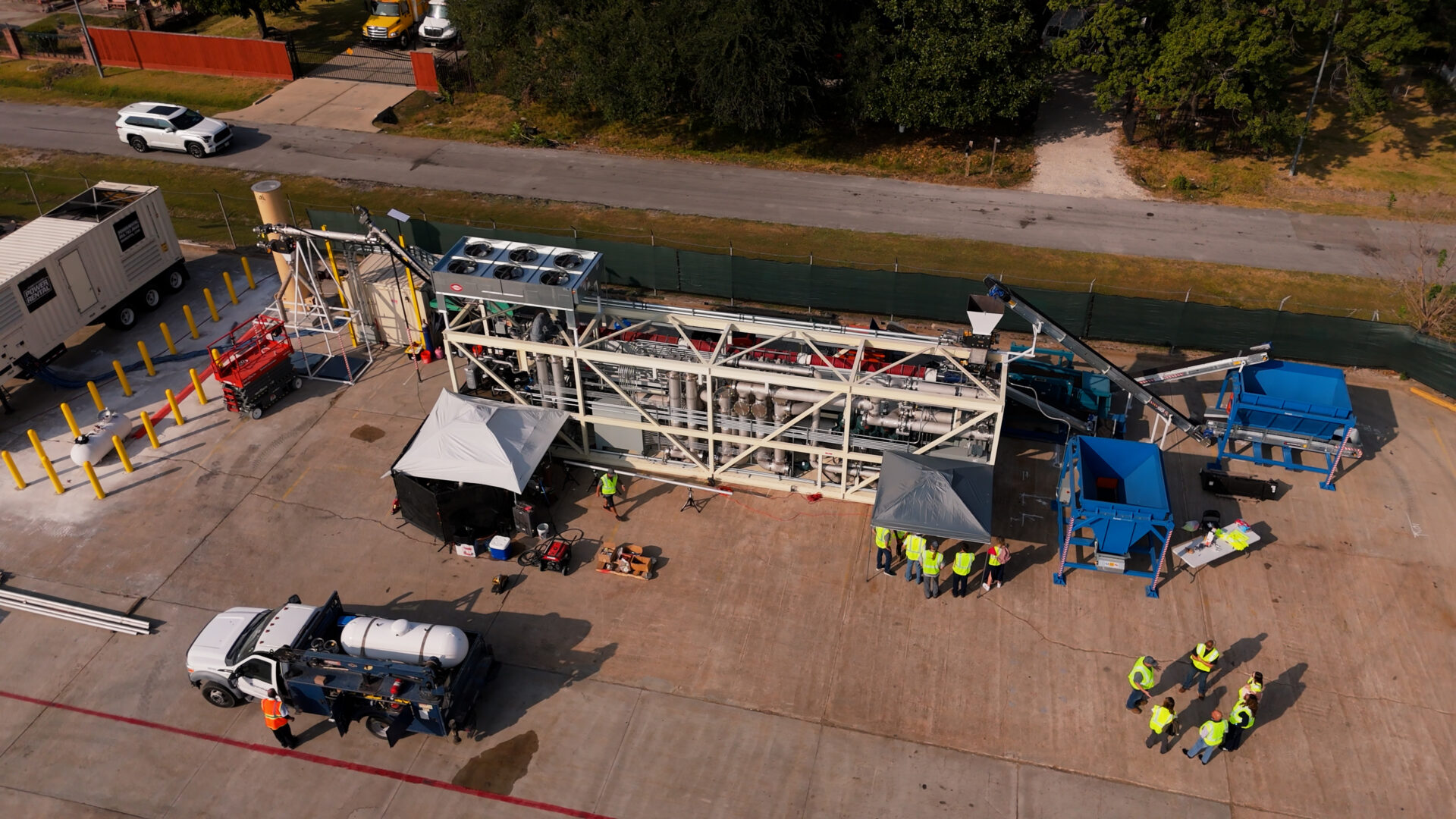
Industrial biochar pyrolysis reactor system by Locoal in Texas
Locoal’s Rainmaker system converts regional wood waste into stable biochar using controlled pyrolysis.

Modern biochar production uses controlled pyrolysis systems. Feedstock type, temperature, and residence time influence the final characteristics of the material. Hardwood biochar produced at higher temperatures behaves differently from lower-temperature agricultural residue char.

Not all biochar is the same and this is something very important to keep in mind.

What Does Biochar Do in Soil?

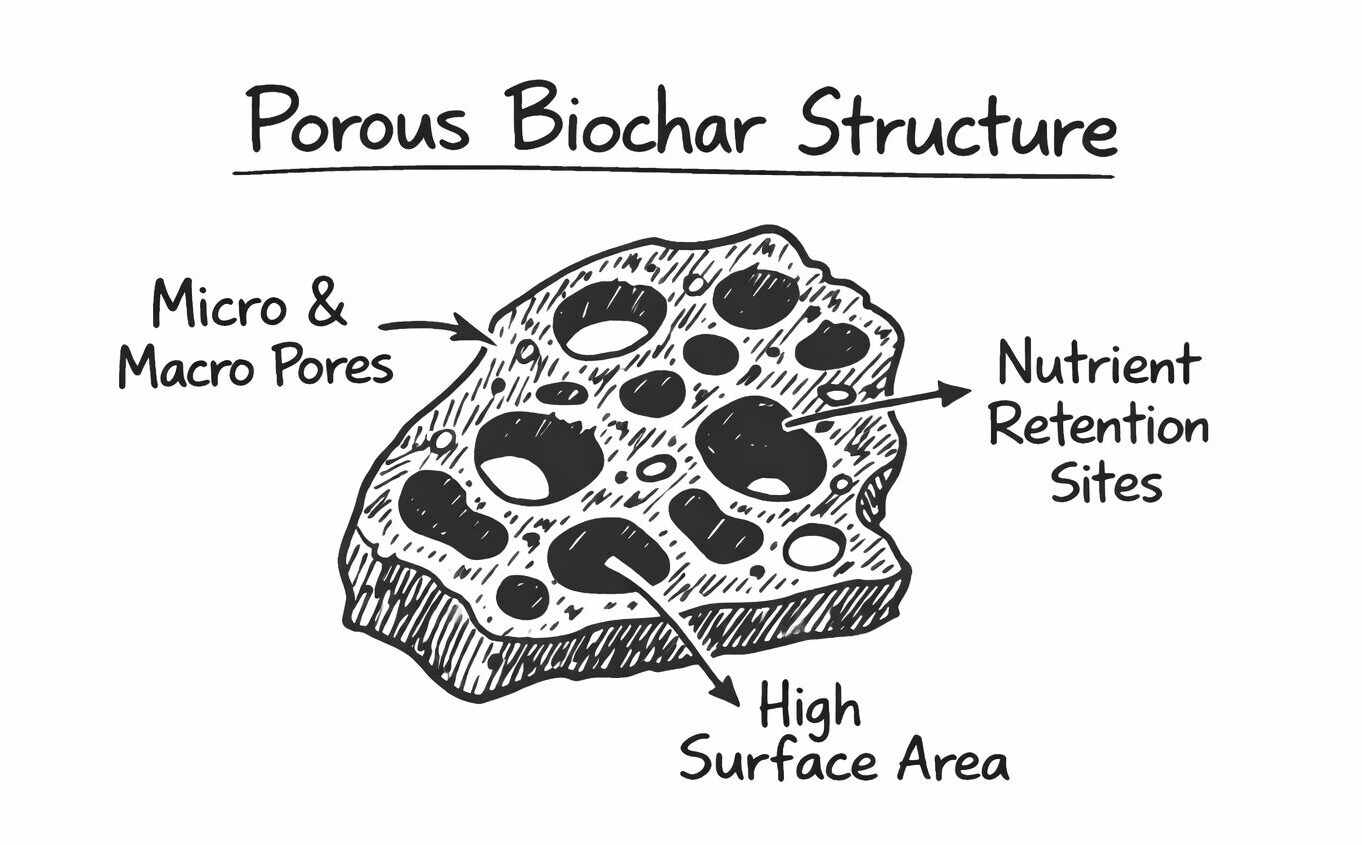
Whiteboard diagram showing porous biochar structure with micro and macro pores

Biochar functions primarily as stable structural carbon.

Its physical structure is highly porous. Under magnification, it resembles a sponge. Those pores provide:

  • Increased surface area

  • Habitat for soil microbes

  • Water retention capacity

  • Sites for nutrient exchange

Biochar is not a fertilizer. It does not directly supply large quantities of plant-available nutrients. Instead, it changes soil structure and supports biological function.

Biochar can increase cation exchange capacity (CEC) in some soil types, helping soils retain positively charged nutrients such as calcium, magnesium, and potassium.

Biochar’s role in improving infiltration ties directly into how soil function alters water movement across landscapes, a concept explored in “Soil Health as the Engine of Water Health in Central Texas.”

Biochar Pros and Cons

Pros of Biochar

1. Long-Term Carbon Stability

Research suggests biochar carbon can remain stable in soils for extended periods. A review of biochar stability in soils can be found in Spokas (2010) published in Carbon Management.

2. Improved Water Retention

A global meta-analysis on biochar and crop productivity found that biochar often improves water holding capacity in coarse soils.

3. Enhanced Microbial Habitat

Biochar provides pore space that supports microbial colonization and root-soil interaction.

4. Nutrient Retention

In some systems, biochar reduces nitrogen leaching and improves nutrient retention dynamics. For more on nitrogen cycling, see this University of Minnesota Extension overview.

5. Waste Stream Utilization

Biochar converts wood waste and biomass into useful soil amendments rather than sending them to landfill.

6. Potential Climate Benefits

A widely cited paper on the climate mitigation potential of biochar was published in Nature Communications (Woolf et al., 2010).

Cons and Limitations of Biochar

1. Not a Fertility Replacement

Biochar does not replace compost, manure, or mineral nutrients.

2. Context-Dependent Performance

Results vary significantly depending on soil type, climate, and management practices.

3. Short-Term Nitrogen Immobilization

Fresh biochar can temporarily reduce plant-available nitrogen if not conditioned properly. Understanding the nitrogen cycle is important when integrating carbon amendments.

4. Variable Quality

Feedstock and pyrolysis temperature significantly influence performance.

5. Economic and Infrastructure Costs

High-quality production requires energy, emissions control, and capital investment.

6. Overstated Claims

Some popular narratives portray biochar as a universal solution. Academic literature supports more nuanced conclusions.

Biochar works best when used intentionally within a broader soil-building system.

What Does Academic Research Say About Biochar?

Carbon Stability

Studies indicate biochar carbon can persist in soils for long time scales. Higher-temperature biochars tend to show greater chemical stability. Lower-temperature biochars may interact more dynamically with soil nutrients but degrade somewhat faster.

Water Retention

A 2013 global meta-analysis found biochar increased water holding capacity in many coarse-textured soils. The effect is strongest in degraded or sandy soils and smaller in clay-rich or already carbon-rich soils.

The effect is strongest in degraded or sandy soils and smaller in clay-rich or already carbon-rich soils.

Nutrient Cycling

In tropical and highly weathered soils, biochar has been shown to increase nutrient retention. For a broader soil science foundation, the USDA Natural Resources Conservation Service provides extensive soil health resources.

Yield Response

Crop yield responses vary widely. Positive effects are more common in low-fertility soils. In high-organic-matter prairie soils, yield effects are often minimal.

The strongest conclusion from the literature is this: biochar performance is site-specific.

Biochar in Texas: Hill Country Context

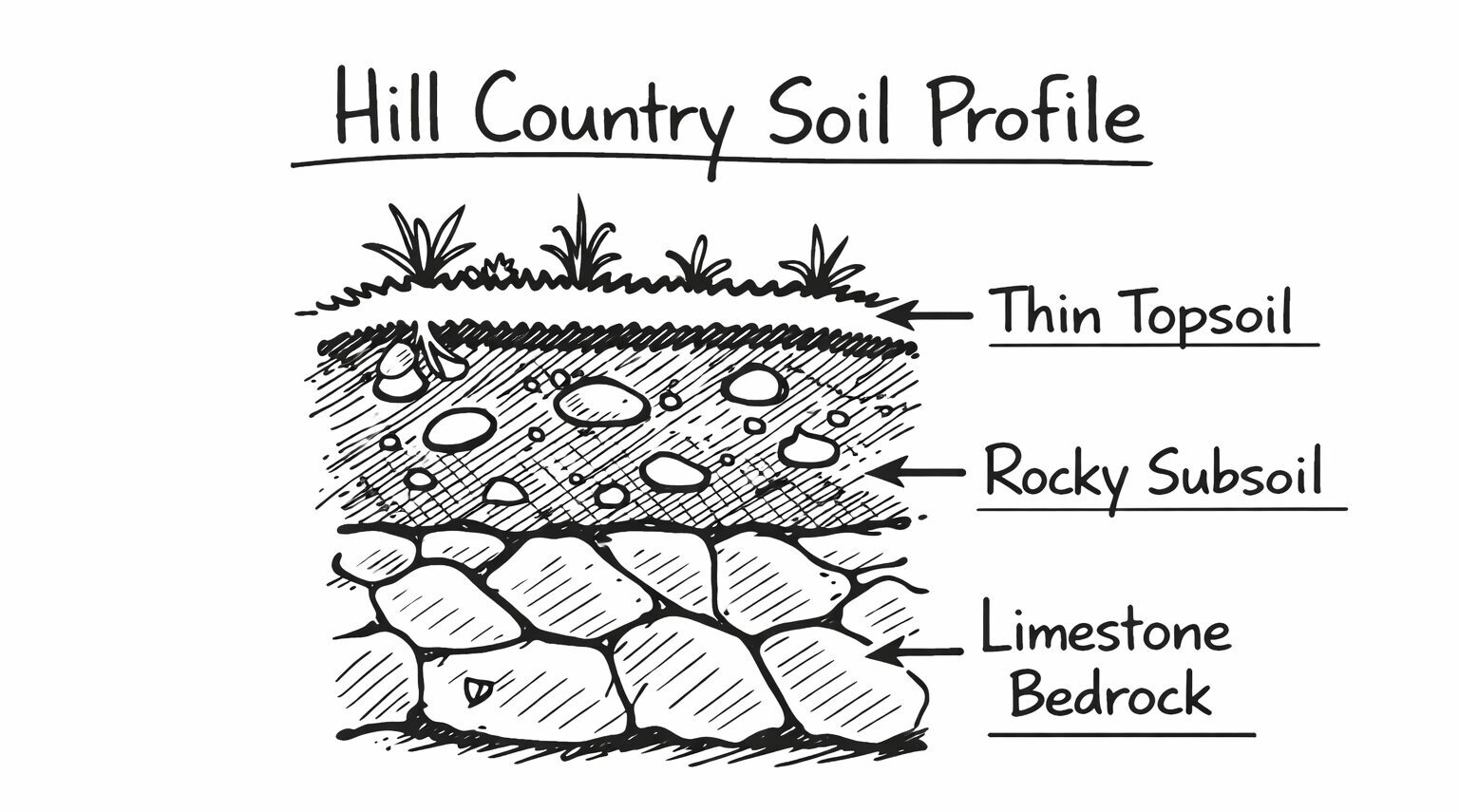
Diagram of Texas Hill Country soil profile showing thin topsoil over limestone bedrock

The Texas Hill Country presents unique constraints:

  • Shallow soils over limestone

  • Often alkaline pH

  • Low native organic matter in many locations

  • Cycles of drought and flash flooding

  • Karst geology with rapid infiltration pathways

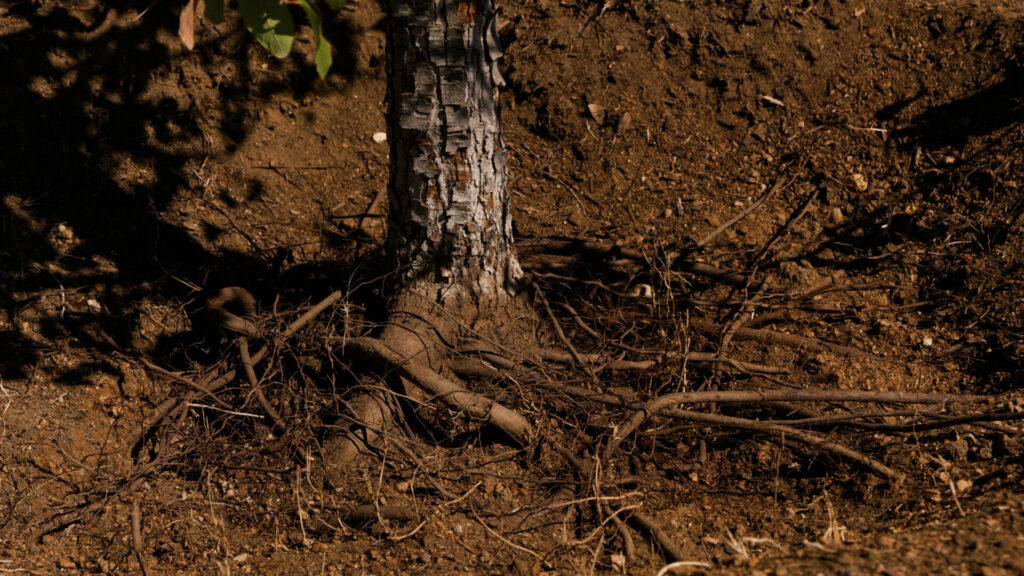
In these systems, soil depth is limited. Building deeper topsoil quickly is unrealistic. Improving structure and function within shallow profiles is often more practical.

Biochar may support:

  • Increased water retention in coarse soils

  • Improved microbial habitat in mineral-dominated systems

  • Stabilized carbon in shallow alkaline soils

Historically, wildfire introduced charcoal into Central Texas landscapes. Modern biochar can be understood as a controlled form of that input.

At Symbiosis TX, biochar is integrated into:

  • Berm systems for improved infiltration

  • Tree planting backfill

  • Restoration zones

  • Compost-amended soil blends

It is pre-charged with biological inputs before application to improve performance.

Understanding Hill Country’s soil and hydrologic history provides essential context for why soil amendments behave differently here than in deeper prairie soils; see “Texas Hill Country Ecology: How the Land, Water, and Landscape Changed.

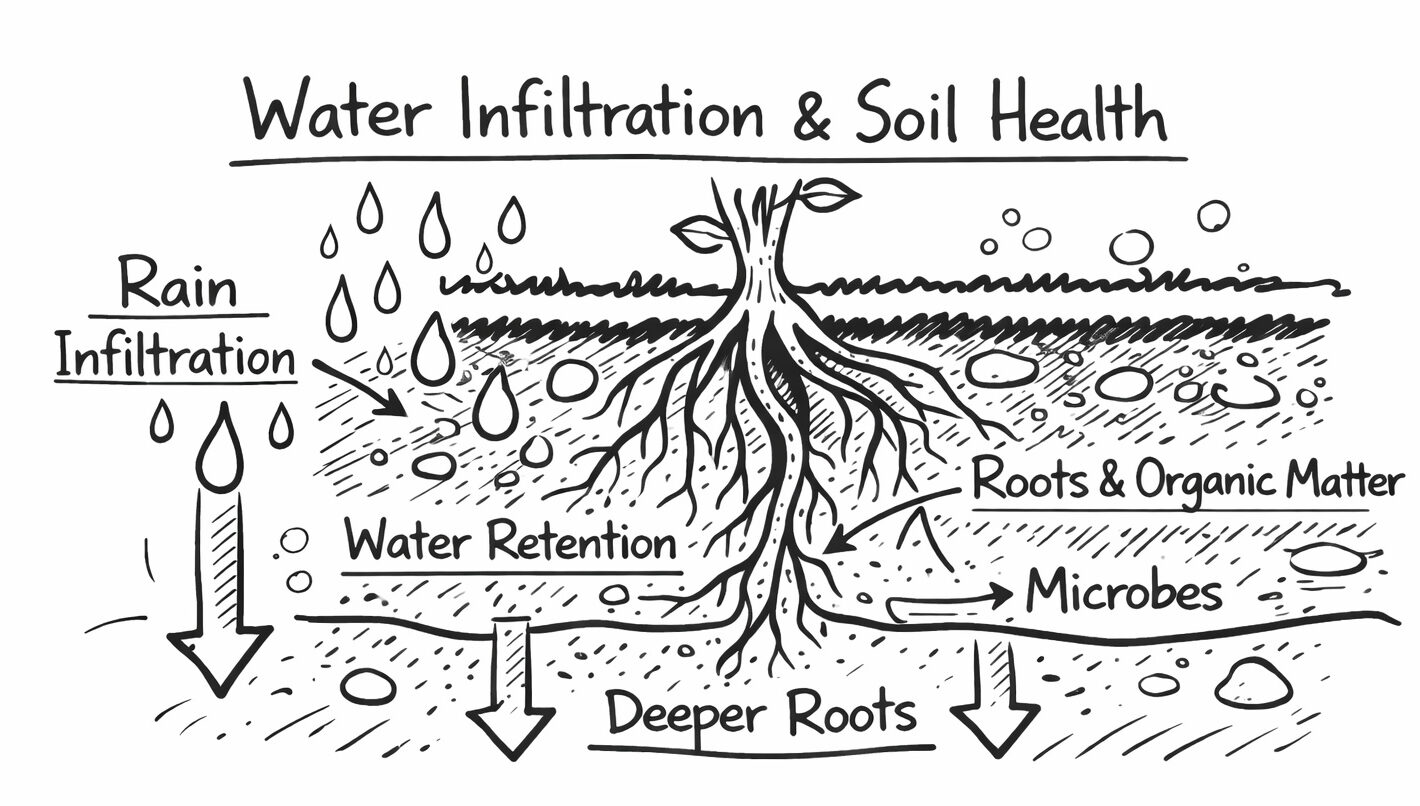
Diagram illustrating water infiltration and soil health improvement with biochar

Biochar and Alkaline Soils in Texas

Many Hill Country soils are alkaline due to limestone parent material. Biochar typically has neutral to alkaline pH.

In alkaline soils, biochar does not function as a liming agent. Instead, its primary contributions are structural:

  • Increased water holding capacity

  • Improved microbial habitat

  • Enhanced nutrient retention dynamics

Research suggests biochar’s hydrological and structural effects are often more important than its pH effects in calcareous soils.

Regional Waste Streams and Circular Systems

Texas produces significant wood waste from:

  • Pallet recycling

  • Cedar clearing

  • Utility line trimming

Through partnerships with regional producers such as Locoal, waste biomass can be converted into soil amendments and renewable energy rather than disposed of.

This keeps carbon local and supports circular design.

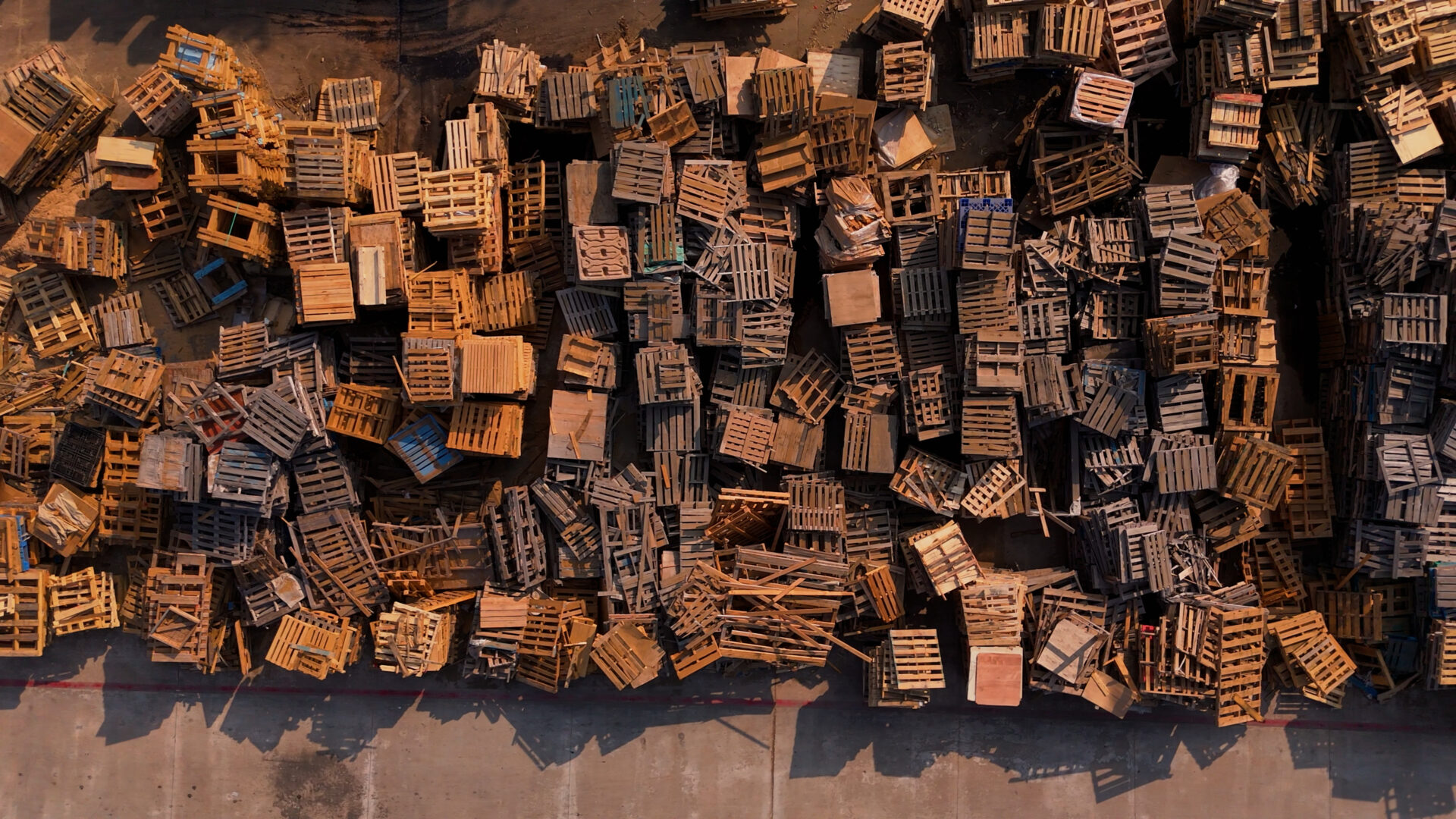
Stacked recycled wooden pallets at Texas recycling facility used for biochar feedstock
Millions of pounds of pallet wood are recycled annually. A portion becomes clean biochar feedstock instead of landfill waste.

Our Biochar Partner – Locoal

At Symbiosis TX, we source our biochar from Locoal, a Texas-based manufacturer specializing in clean, high-quality biochar production.

Locoal operates an advanced, digitally controlled pyrolysis system that converts regional wood waste into stable carbon. Their process includes feedstock screening, contaminant removal, precise temperature control, and full data transparency throughout production. This ensures consistent material quality and minimizes emissions during processing.

By working with a regional producer, we are able to verify feedstock sourcing and ensure the biochar we apply on our projects comes from clean, diverted wood waste streams rather than treated lumber or contaminated material.

This partnership also keeps carbon local. Wood waste generated in Texas is converted into soil-building material for Texas landscapes, aligning soil regeneration with circular resource management.

In our companion video, we visit Locoal’s facility to document the production process and explain how industrial-scale systems can support regenerative land management when thoughtfully integrated.

Final Perspective

Biochar is not a silver bullet but instead it is one of many tools to consider using depending on your context and needs.

Its strongest benefits appear in:

  • Low organic matter soils

  • Semi-arid regions

  • Degraded landscapes

  • Coarse or sandy soils

Its impact is often smaller in:

  • Deep prairie Mollisols

  • High-organic-matter soils

  • Systems already rich in stable carbon

In Texas Hill Country regeneration, biochar is integrated as part of a systems-based approach that includes composting, hydrological design, and ecological restoration.

Because performance varies by site and system scale, adopting biochar fits into adaptive decision frameworks like those discussed in “Adaptive Management in Central Texas: Monitoring, Learning, and Recovery.”

Its value depends on context and thoughtful application.

Biochar FAQ: What It Is, How It Works, and When It Makes Sense in Texas

What problem does biochar solve in Central Texas?

Biochar helps address low organic matter, limited water retention, and shallow soil depth common in the Texas Hill Country. In limestone-based soils that drain quickly or erode during heavy rain, biochar can improve soil structure, increase water holding capacity, and support microbial life. It functions as stable carbon that strengthens soil over time rather than decomposing quickly.

Is biochar a fertilizer?

No. Biochar is not a fertilizer. It does not directly supply significant nutrients to plants. Its primary role is structural and biological. Biochar increases pore space, supports microbial habitat, and can help retain nutrients already present in the soil. It performs best when integrated with compost, manure, or other biological inputs.

Does biochar work in alkaline soils like the Hill Country?

Yes, but its benefits are structural rather than pH-related. Most Hill Country soils are alkaline due to limestone parent material. Biochar typically does not lower soil pH. Instead, it improves water retention, microbial habitat, and nutrient retention dynamics in shallow, mineral-heavy soils.

Does biochar increase water infiltration?

Yes. By improving soil aggregation and pore structure, biochar can increase infiltration and reduce runoff in coarse or rocky soils. In drought-prone regions like Central Texas, increased water holding capacity can support deeper root establishment and reduce plant stress during dry periods.

Can biochar help prevent erosion?

Indirectly, yes. Biochar improves soil structure and supports vegetation establishment. Stronger root systems and improved ground cover reduce erosion risk over time. When used alongside berms, terraces, or contour strategies, biochar can support long-term soil stabilization.

How long does biochar last in soil?

Biochar is highly stable. Research suggests it can persist in soil for decades and potentially centuries depending on production temperature and environmental conditions. Higher-temperature biochars tend to be more chemically stable and resistant to breakdown.

Does all biochar perform the same way?

No. Feedstock type, pyrolysis temperature, particle size, and application method all influence performance. Hardwood biochar differs from agricultural residue biochar. High-temperature production produces more stable carbon but may reduce reactive surface chemistry. Quality and sourcing matter.

Should biochar be applied directly to soil?

Biochar performs best when pre-charged with compost, compost tea, manure, or other biological inputs before application. Raw biochar can temporarily immobilize nitrogen in some soils. Charging allows pores to absorb nutrients and microbes prior to incorporation.

Is biochar expensive?

Costs vary depending on sourcing and scale. Commercially produced biochar requires infrastructure and processing energy. On larger projects, local sourcing and waste-stream partnerships can reduce costs. Compared to repeated fertilizer inputs, biochar represents a long-term soil investment rather than a short-term amendment.

Can biochar be made at home?

Small-scale biochar production is possible, but it requires controlled heating in low-oxygen conditions to avoid creating ash instead of stable carbon. Improper production can generate air pollution or inconsistent material quality. Commercial systems provide more consistent production and emissions control.

Does biochar improve crop yields?

Research shows variable yield responses. Yield improvements are more common in degraded, low-organic-matter, sandy, or tropical soils. In fertile prairie soils with high organic matter, yield gains may be minimal. Biochar’s strongest benefits are often structural and hydrological rather than immediate productivity boosts.

Does biochar help with drought resilience?

Yes, particularly in coarse or shallow soils. Biochar can increase water retention and improve plant survival during extended dry periods. In semi-arid regions like the Texas Hill Country, this can support tree establishment and long-term vegetation stability.

Can biochar reduce climate change?

Biochar stabilizes carbon that would otherwise return to the atmosphere through decomposition or burning. When produced responsibly and integrated into soil, it can contribute to long-term carbon sequestration. Its climate impact depends on feedstock sourcing, production method, and lifecycle emissions.

Is biochar a silver bullet for soil health?

No. Biochar is one tool within a broader regenerative strategy. It works best when combined with composting, cover cropping, hydrological design, and ecological restoration. Its effectiveness depends on context and thoughtful integration.

How do we use biochar at Symbiosis TX?

In the Texas Hill Country, we integrate biochar into berm systems, tree planting backfill, and restoration zones. We pre-charge it with biological inputs before application. We source regionally produced biochar derived from clean wood waste streams, aligning soil building with circular resource management.

Academic References

Below are widely cited peer-reviewed sources relevant to biochar research:

Lehmann, J., & Joseph, S. (2009). Biochar for Environmental Management: Science and Technology. Earthscan.

Lehmann, J., et al. (2011). Biochar effects on soil biota. Soil Biology and Biochemistry, 43(9), 1812–1836.

Jeffery, S., et al. (2013). A quantitative review of the effects of biochar application to soils on crop productivity using meta-analysis. Agriculture, Ecosystems & Environment, 144(1), 175–187.

Biederman, L. A., & Harpole, W. S. (2013). Biochar and its effects on plant productivity and nutrient cycling: A meta-analysis. GCB Bioenergy, 5(2), 202–214.

Woolf, D., et al. (2010). Sustainable biochar to mitigate global climate change. Nature Communications, 1(56).

Spokas, K. A. (2010). Review of the stability of biochar in soils. Carbon Management, 1(2), 289–303.

Glaser, B., et al. (2002). Ameliorating physical and chemical properties of highly weathered soils in the tropics with charcoal. Biology and Fertility of Soils, 35, 219–230.

Mukherjee, A., & Lal, R. (2013). Biochar impacts on soil physical properties and greenhouse gas emissions. Agriculture, Ecosystems & Environment, 191, 32–39.

Texas A&M AgriLife Extension publications on soil health and biochar applications in Texas soils.

Related Educational Context

For foundational context across land regeneration and water health, visit our Central Texas Land Regeneration Education hub.

What is Biochar and Does It Actually Work?

Home / What Is Biochar? Science, History, Pros and Cons, and Its Role in Texas…

Limestone Terraces in Central Texas for Erosion Control and Soil Building

Home / Limestone Terraces in Central Texas: Erosion Control, Soil Building, and Hill Country Restoration…

Applying Wildfire Science to Land Stewardship in Central Texas

Home / Applying Wildfire Science to Land Stewardship in Central Texas Companion article to Episode…

Overgrazing in the Texas Hill Country

Home / Overgrazing in the Texas Hill Country Why Timing, Movement, and Recovery Matter More…

Karst Hydrology and Water Movement in the Texas Hill Country

Home / Karst Hydrology and Water Movement in the Texas Hill Country How Fractured Limestone…

Scale and Fragmentation in Central Texas Land and Water Systems

Home / Scale, Fragmentation, and Why Good Practices Don’t Always Scale Why Scale and Fragmentation…